Four pearl varieties share almost the entire cultured pearl market, and each comes from a different mollusc. That explains size, colour and nacre thickness better than any price list, and it explains why one necklace can cost 100 euros and another 50,000.
Four molluscs, four pearls
CIBJO, the World Jewellery Confederation, assigns every cultured pearl to its mollusc. The Akoya pearl grows in Pinctada fucata martensii, a small oyster from the cool coastal waters of Japan and China. The South Sea pearl comes from Pinctada maxima, the silver-lipped or gold-lipped oyster found off Australia, Indonesia and the Philippines. The Tahitian pearl is formed by Pinctada margaritifera cumingii, the black-lipped oyster of French Polynesia. Freshwater pearls grow in mussels of the genus Hyriopsis, above all in the triangle mussel Hyriopsis cumingii from Chinese lakes and ponds.
The most important difference lies in the yield. A saltwater oyster usually carries one or two mother-of-pearl nuclei: polished beads cut from mussel shell, around which the nacre grows. A freshwater mussel accepts 12 to 16 pieces of tissue per shell half and produces 24 to 32 pearls in a single cycle; it used to be as many as 50. That figure accounts for most of the price gap.
| Pearl variety | Mollusc and origin | Typical size | Colours | Nacre thickness | Culturing time | Pearls per mollusc |
|---|---|---|---|---|---|---|
| Akoya | Pinctada fucata martensii, Japan and China | 6 to 8 mm, rarely over 9 mm | White, cream, rosé overtone | 0.15 to 0.50 mm | 10 to 24 months | 1 to 2 |
| South Sea | Pinctada maxima, Australia, Indonesia, Philippines | 8 to 18 mm, single pieces up to 20 mm | White, silver, gold | 2 to 6 mm according to dealers | around 2 years per harvest, up to 3 harvests | 1 |
| Tahitian | Pinctada margaritifera cumingii, French Polynesia | 8 to 14 mm, rarely over 16 mm | Grey, charcoal, brown with green, blue, violet | formerly an official minimum of 0.8 mm | 12 to 18 months per cycle | 1 |
| Freshwater | Hyriopsis cumingii, China | 2 to 13 mm | White, rosé, apricot, lavender, metallic | solid nacre, usually without a nucleus | 2 to 4 years per cycle | 24 to 32, formerly up to 50 |
Size and shape
The Akoya pearl is the smallest of the four. GIA, the Gemological Institute of America, gives its typical diameter as under 9 mm; most necklaces are sold in 6 to 8 mm, and anything over 10 mm counts as an exception. In return, the Akoya is the roundest, because the nucleus is a polished bead and the thin layer of nacre keeps its shape. Tahitian pearls, according to GIA, mostly fall between 8 and 14 mm, South Sea pearls between 8 and 18 mm.
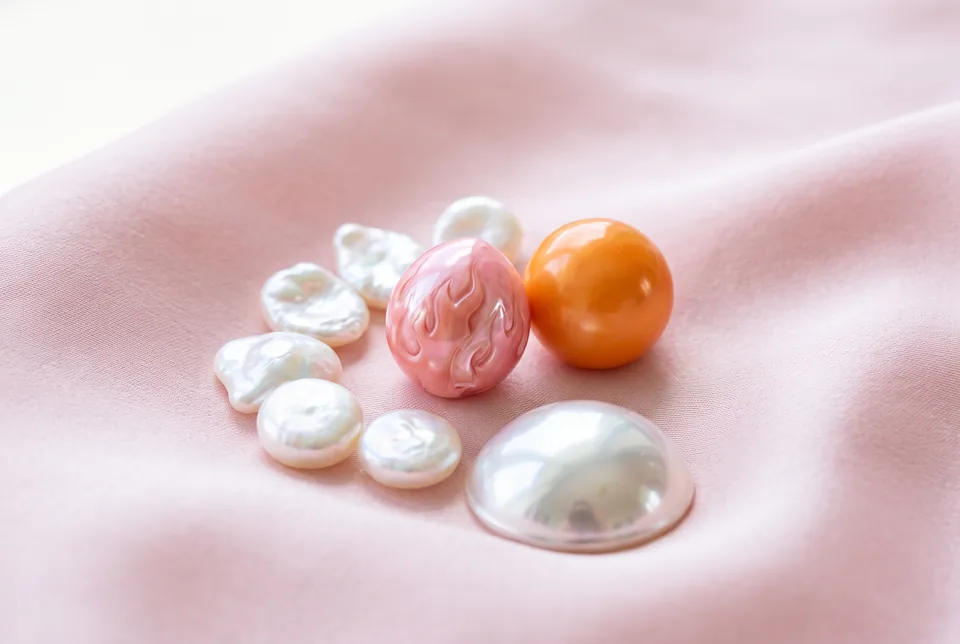
With the large saltwater pearls, the diameter grows with each culturing cycle, because a proven oyster receives a larger nucleus: for Tahitian pearls the first harvest yields 8 to 10 mm and the third 13 to 16 mm; for South Sea pearls the first harvest starts at 10 to 12 mm and a rare third reaches 20 mm. Freshwater pearls mostly stay under 13 mm and are rarely perfectly round, but they come in drops, buttons and baroque shapes like nowhere else.
Colour and lustre
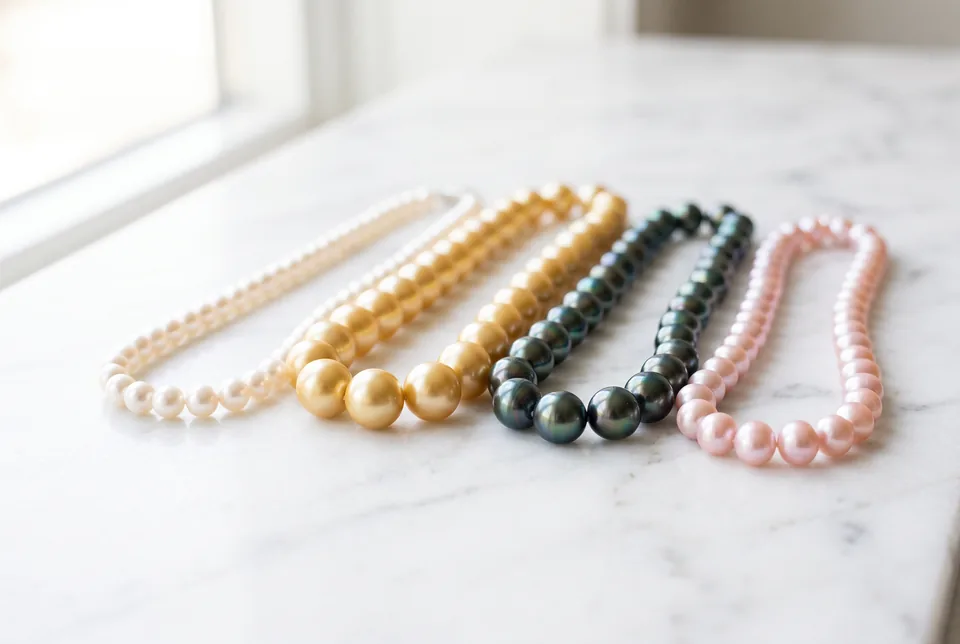
Colour is the quickest way to tell the four varieties apart. Akoya pearls are white to cream, often with a rosé overtone, and have the sharpest, most mirror-like lustre. South Sea pearls range from white through silver to a rich gold that commands prices of its own; their lustre is softer and looks like satin. Tahitian pearls are the only pearl variety traded in volume with a naturally dark colour; beyond them there are only small harvests from Fiji and the Gulf of California. Their palette runs from grey, charcoal and brown with overtones of green, blue, violet or pink to the sought-after peacock shade. Freshwater pearls cover pastel tones from white through rosé and apricot to lavender, some with a metallic sheen.
A black Akoya or a black freshwater pearl has been dyed or irradiated. That is permitted, but under the CIBJO rules it must be disclosed at the point of sale. Anyone looking for a dark pearl without colour treatment almost always ends up with Tahitian.
Nacre and culturing time
Nacre is the layer of aragonite and protein that the mollusc lays down around the nucleus. CIBJO notes that its thickness is closely tied to the culturing time and can influence colour, lustre and durability without being a measure of quality in itself. In the Akoya it is thinnest: GIA gives 0.15 to 0.50 mm of nacre for conventional Akoya pearls. The minimum culturing time is regarded as 10 to 14 months. The Japanese testing laboratory awards the Hanadama designation only from 0.4 mm. Good farms leave the oysters in the water for 18 to 24 months, because cold winter water between 15 and 20 °C produces the densest nacre.
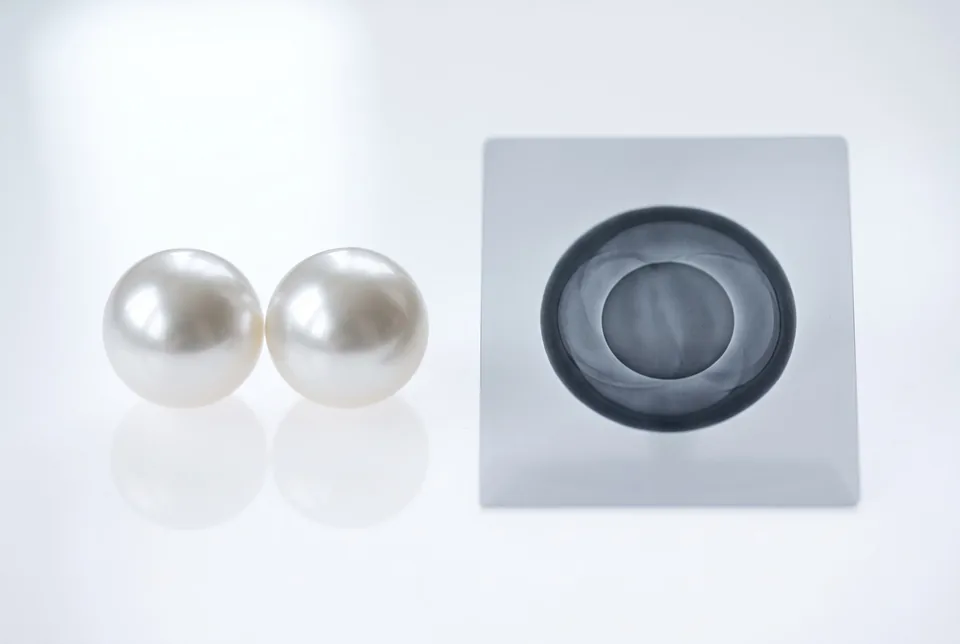
Tahitian pearls stay in the water for 12 to 18 months per cycle. Until the end of 2016, French Polynesia was allowed to export only pearls whose X-ray image showed at least 0.8 mm of nacre over 80 percent of the surface; the rest was destroyed. Since January 2017 the inspection has been voluntary. South Sea pearls grow for about two years per harvest, and because the oyster is re-nucleated up to three times, it spends up to six years in culture; dealers quote nacre thicknesses of 2 to 6 mm. Freshwater pearls usually consist entirely of nacre, because only a piece of mantle tissue and no nucleus is inserted; a harvest cycle there takes 2 to 4 years. The process is described step by step in How cultured pearls are made.
What a necklace costs
Pearls are traded almost everywhere in US dollars; the euro figures here are rounded conversions. The catalogue of a Spanish South Sea pearl dealer who buys directly from farms in Australia, Indonesia and the Philippines lists Akoya strands at 300 to 1,500 dollars, Tahitian strands at medians of 780 to 1,230 dollars, and white South Sea strands in 12 to 13 mm at up to around 5,200 dollars. A large US dealer sets the lower limit for Tahitian and South Sea at 2,500 dollars, the upper limit for South Sea at 100,000 dollars and more, and quotes 10,000 to 11,000 dollars for Hanadama Akoya.
| Pearl variety | Entry level | Good commercial quality | Top end |
|---|---|---|---|
| Freshwater | from around EUR 100 | EUR 20 to 300 for most pieces | single pieces well above that |
| Akoya | from around EUR 300 | up to around EUR 1,500 | EUR 9,000 to 10,000 (Hanadama, 9 mm and above) |
| Tahitian | from around EUR 700 (catalogue medians) | EUR 700 to 2,300, depending on the dealer | several thousand euros, open-ended |
| South Sea, white and gold | from around EUR 2,300 | EUR 3,500 to 4,700 (12 to 13 mm) | up to over EUR 90,000 (large strands in top quality) |
The premium arises in the sorting. A necklace needs more than 30 pearls that match in colour, overtone and lustre, and such twins are rare. That is why the range for white South Sea in 12 to 13 mm in the same catalogue runs from under 300 to over 5,000 dollars per strand; the median in June 2026 was around 2,000 dollars. Baroque shapes cost 30 to 70 percent less for the same lustre. The quality grades are explained in AAA, AA or A, and the full price list is in What a pearl necklace costs.
Which pearl for which budget and occasion
- Up to EUR 500: freshwater pearls in 7 to 9 mm, as round as possible and with a clean surface. The best choice for everyday wear and as a first piece of pearl jewellery.
- EUR 500 to 1,500: an Akoya necklace in 7 to 7.5 mm with a rosé overtone. The classic strand for weddings, work and evenings, smaller than South Sea but with the sharpest lustre.
- EUR 1,500 to 3,000: Tahitian pearls in 9 to 11 mm in mixed colours. Dark, modern, and the cheapest saltwater pearl relative to its size.
- EUR 3,000 to 6,000: white South Sea pearls in 10 to 12 mm or a single pendant in 13 mm. A calm satin lustre and a grand presence.
- From EUR 6,000: golden South Sea pearls or white South Sea over 13 mm. Here a laboratory report documenting nacre thickness and any colour treatment is worth having.
Why freshwater became so cheap
The cultured pearl is a Japanese invention. Kokichi Mikimoto produced the first attached half pearl in 1893, and within a little over 30 years it had grown into an industry: the first official statistics from 1926 count 33 farms with 669,000 oysters, and by 1937 there were 258 farms with 10,858,000 oysters. China adopted the technique for freshwater mussels and is today the only producer of any note, with 1,500 tonnes in 2005 alone. Dozens of pearls per mussel, no cost for nuclei, and ponds instead of sea bays: that is how a necklace for 100 euros became possible.
For the buying decision this means: freshwater for quantity and variety of colour, Akoya for lustre and classic shape, Tahitian for dark tones without dyeing, South Sea for size and nacre thickness. Anyone in doubt should choose the smaller pearl in better quality. A sharp lustre catches the eye every day; an extra millimetre of diameter no longer does after a week.
The pearl probe
Grab and turn, or pick a tone: the pearl shows how Akoya, South Sea, Tahitian and freshwater pearls behave in the light.
Frequently asked questions
Which pearl variety is the most valuable?
South Sea pearls from Pinctada maxima fetch the highest prices. A dealer catalogue lists white strands in 12 to 13 mm at up to 5,200 dollars, and for large South Sea strands in top quality dealer prices reach 100,000 dollars and more. The reasons are size, nacre of 2 to 6 mm and just one pearl per oyster.
Are freshwater pearls real pearls?
Yes, freshwater pearls are genuine cultured pearls from mussels of the genus Hyriopsis. They usually consist of solid nacre throughout, because no nucleus is inserted. They are inexpensive because one mussel produces 24 to 32 pearls per cycle, whereas a saltwater oyster produces only 1 to 2.
How long does it take for a pearl to grow?
Akoya pearls grow for 10 to 24 months, Tahitian pearls 12 to 18 months per cycle, South Sea pearls around 2 years per harvest, freshwater pearls 2 to 4 years. Because South Sea oysters are re-nucleated up to three times, their productive life lasts up to 6 years. The longer in the water, the thicker the nacre.
What is the difference between Tahitian and South Sea pearls?
Both are large saltwater pearls, but from different oysters. Tahitian pearls from Pinctada margaritifera are naturally grey to black with green, blue or violet overtones and measure 8 to 14 mm. South Sea pearls from Pinctada maxima are white, silver or golden, grow up to 18 mm and usually cost two to three times as much per necklace as a Tahitian necklace of the same size.
Which pearls make a good first pearl necklace?
For under EUR 500 a freshwater necklace in 7 to 9 mm is the best choice; for EUR 800 to 1,500 an Akoya necklace in 7 to 7.5 mm. Both are suitable for everyday wear and classic. More important than size is a dense, sharp lustre.
Sources
- What are the main types of cultured pearls and what are their distinctive characteristics? Gemological Institute of America (GIA)
- The Four Major Types of Cultured Pearls Gemological Institute of America (GIA)
- Exceptional Nacre Thickness of Hybrid Akoya Bead Cultured Pearls, Gems & Gemology Summer 2025 Gemological Institute of America (GIA)
- CIBJO Pearl Book 2024, Pearl Commission CIBJO, The World Jewellery Confederation
- Nagai, K. (2013): A History of the Cultured Pearl Industry, Zoological Science 30(10) Zoological Society of Japan / BioOne
- South Sea Pearl Prices 2026, Real Price Chart by mm The South Sea Pearl
- How Much Are Pearls Really Worth? A Pearl Farmer's Answer The South Sea Pearl
- How Much Do Pearls Cost? Value & Worth Guide Pearls of Joy
- Akoya Pearls Explained: Nacre, Hanadama, Color and Value Pearl Paradise
- Akoya Today Pearls Only
- South Sea Pearls Pearl-Guide
- The Freshwater Pearl Industry Skyjems
- Tahitian minimum nacre depth law scrapped Pearlescence
- Die Zucht der Tahitiperlen (Tahitian pearl farming, in German) Taaroa Bijoux, French Polynesia
- Ratgeber zu den Perlenarten (Guide to pearl varieties, in German) Brogle
- Cultured freshwater pearls Wikipedia