The operation takes a few minutes; the result takes years. Between surgery and harvest lie growth, cleaning, storms, heat and disease, and at the end only a small share of the crop is round and flawless. Anyone who understands what happens inside the shell reads prices and grades with different eyes afterwards.
What the farmer borrows from nature
A pearl is the mollusc's response to an injury to its mantle. The mantle is the thin layer of tissue that lines the shell from the inside and secretes nacre. If a piece of that tissue ends up inside the animal's body, it closes into a small pouch, the pearl sac, and carries on producing nacre there, only all the way round instead of in a flat sheet. That was the insight that matured around 1900 in Japan and Europe: it is not the grain of sand that makes the pearl but the stray mantle tissue. Tokichi Nishikawa and Tatsuhei Mise turned it into the technique that underlies every beaded cultured pearl to this day. Kokichi Mikimoto took it to industrial scale after producing the first half-round cultured pearl in 1893.
In its Pearl Book 2024, the world confederation CIBJO defines a cultured pearl as one that grows in a pearl sac created by human intervention through the implantation of mantle tissue, with or without a nucleus. What truly separates natural from cultured pearls is explained in Natural or cultured pearl.
A bead from the Mississippi as the nucleus
The nucleus, the core around which a saltwater pearl grows, is a perfectly round, polished bead of mollusc shell. Traditionally it comes from the thick-shelled freshwater mussels of the Mississippi and Tennessee rivers, which were gathered there for the button industry as early as the 19th century. According to a 2013 study by the Swiss laboratory SSEF, all the species used belong to the family Unionidae, around 80 per cent of US shell production comes from Tennessee, and 10 species may be harvested commercially there.
The nuclei are sawn from strips of shell, ground round and polished. According to CIBJO they range from about 2 to 14 mm, depending on the mollusc species. With Akoya, every flaw in the nucleus shows, because the layer of nacre over it is thin and any banding in the shell shines through. Because the Mississippi stocks suffer from overfishing and pollution, large nuclei have become expensive: one Polynesian farm quotes up to 2,200 euros per pound, roughly 450 grams, for the largest sizes.
The operation takes a few minutes
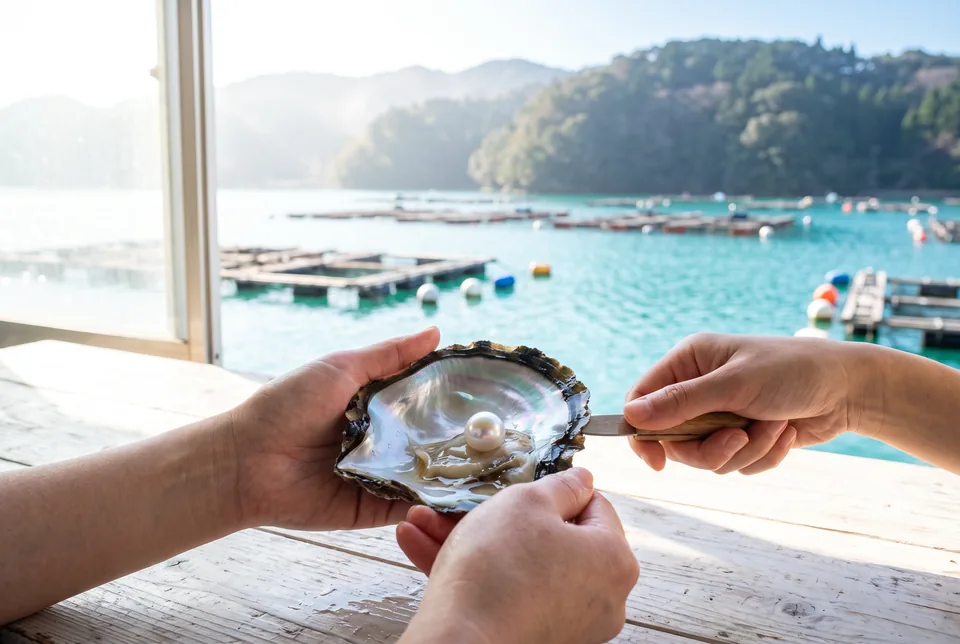
Before the operation the oysters are conditioned so that the gonad, the reproductive gland, shrinks back. The farmer then opens the shell with a spreader that, according to Kiyohito Nagai, was derived from a dentist's instrument. With a fine scalpel he cuts a channel to the gonad, pushes the nucleus in and places the saibo right next to it: a piece of mantle tissue a few millimetres across, cut from a donor oyster sacrificed for the purpose. The donor oyster helps determine the colour of the future pearl, the host oyster its shape and lustre.
An Akoya oyster receives one or two nuclei, a South Sea or Tahitian oyster only one. Over the first few weeks the tissue grows around the nucleus to form the pearl sac; Tahitian farms hang the freshly operated animals in individual net bags for a few days so that any rejected nuclei can be recovered. Beadless freshwater culture works differently: the farmer cuts small pockets into the mantle of the mussel itself and places a piece of tissue in each one, historically up to 50 per animal, 25 in each valve, today far fewer because the farms are aiming for larger and rounder pearls.
The years in the water
After the operation the animals rest for a few weeks in sheltered nets, then they hang on lines or in baskets in open water. The nacre is laid down in fine layers of aragonite, a form of calcium carbonate, and conchiolin, a protein. Cold water slows the metabolism and produces denser layers, which is why Japanese farms prefer to harvest in winter. An Akoya needs at least ten months, and 18 to 24 months count as well grown. Certification as Hanadama, the top tier for Akoya, requires a nacre thickness of 0.4 mm or more.
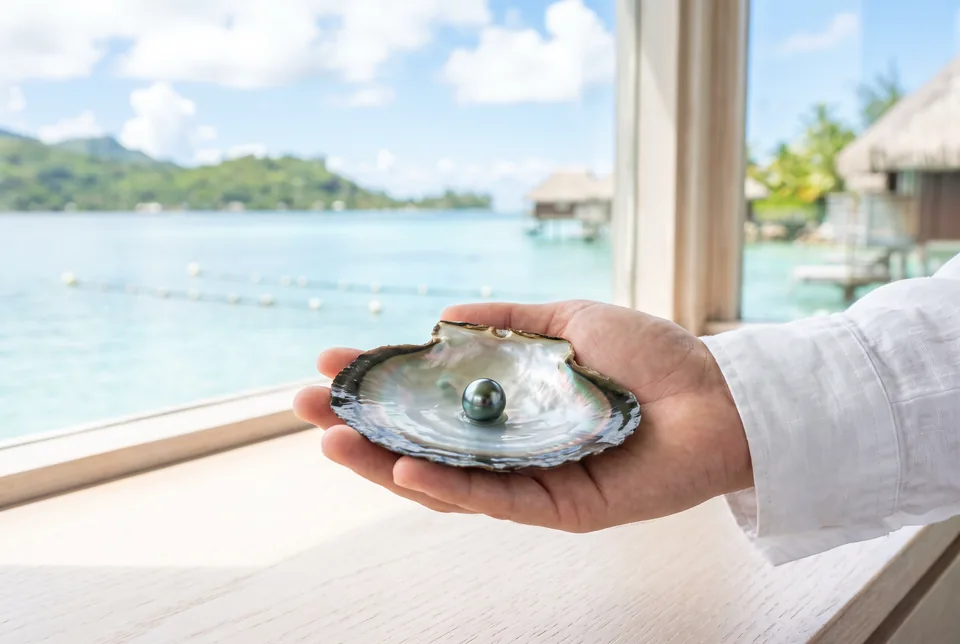
Tahitian pearls stay in the lagoon for 12 to 18 months, and French Polynesia requires a minimum of 0.8 mm of nacre for export. South Sea pearls from Pinctada maxima grow for two to three years, at least two and usually longer; according to GIA they range from 8 to 20 mm with an average of 13 mm. Beadless freshwater pearls consist almost entirely of nacre and usually stay in the mussel for several years; an overview by the German broadcaster WDR gives two to five years for cultured pearls in general.
| Pearl type | Mollusc | Nucleus | Growth period | Yield per animal and cycle |
|---|---|---|---|---|
| Akoya | Pinctada fucata, Japan, China, Vietnam | Shell bead, 1 to 2 per oyster | 10 to 24 months | 1 to 2 pearls, under 5% top quality |
| Tahitian | Pinctada margaritifera, French Polynesia | Shell bead, 1 per oyster | 12 to 18 months, up to 3 cycles | 1 pearl; from 100,000 oysters around 45,000 saleable, about 2% round and grade A |
| South Sea | Pinctada maxima, Australia, Indonesia, Philippines | Shell bead, 1 per oyster | two to three years, several cycles possible | 1 pearl, 8 to 20 mm, 13 mm on average |
| Freshwater, beadless | Hyriopsis cumingii, China | no nucleus, tissue pieces only | several years | historically up to 50 pearls, today fewer and larger |
| Freshwater, beaded | Hyriopsis cumingii and hybrids, China | Shell bead or freshwater pearl as nucleus | several years | few pearls, but large ones |
Losses, rejection and the second operation
Figures from a farm in the Tuamotu Islands show the attrition. After the operation, around 40 per cent of the Tahitian oysters die or reject the nucleus. From 100,000 operated animals the farm hopes for 45,000 saleable pearls, and only about 2 per cent of those are round and in the top grade. Around 30,000 oysters that have delivered a good pearl are operated on a second time: a larger nucleus goes into the existing pearl sac, producing pearls of 10 to 13 mm, though about 20 per cent of the animals are lost to predators. For Akoya, one specialist dealer states that fewer than half the oysters survive the operation and under 5 per cent of the harvest reaches high quality.
If the animal rejects the nucleus but the pearl sac keeps working, the result is a keshi, made entirely of nacre. More on this in the article on keshi, mabe, conch and melo pearls.
Red tides and a virus
Dependence on a living animal makes pearl farming vulnerable. Nagai reports that in Ago Bay, from January to March 1905, a red tide, a toxic algal bloom, killed 850,000 of just over a million cultured oysters, four fifths of the stock by his account. The industry recovered: in 1926 the first official statistics counted 33 farmers with 669,000 oysters, and by 1937 there were 258 farmers with 10,858,000 oysters.
The most recent blow came in 2019. From June onwards, juvenile oysters died in huge numbers in the prefectures of Mie and Ehime, and later in Nagasaki, Kumamoto and Oita too. A survey by the Mie Prefecture Fisheries Research Institute found a mortality rate for 2019 of 56 to 74 per cent among juveniles and 23 to 24 per cent among adult oysters, compared with 15 per cent and 9 to 16 per cent in normal years. In 2024 Japanese researchers identified the cause as a previously unknown birnavirus, the Pinctada birnavirus. The loss of the juveniles works with a delay, since only fully grown oysters are operated on: Japanese Akoya production fell to around 13.2 tonnes in 2023, the lowest figure since records began in 1956, compared with 138 tonnes in the peak year of 1967.
What pearl farms ask of the water
A pearl farm needs clean, nutrient-rich and calm water, and it occupies a great deal of it. In French Polynesia, according to the 2023 statistics of the Direction des Ressources Marines, a total of 7,609 hectares of lagoon were under concession for pearl farming, spread across 27 islands. 325 pearl producers with a professional licence and 412 oyster breeders were registered. Around 11.1 million pearls were exported, worth 16.9 billion Pacific francs, roughly 140 million euros.
The oysters have to be cleaned of algae and fouling several times per cycle; the Tahitian farm cites at least two cleanings in 12 to 18 months. On the lagoon floor small fish do this work, but on the culture lines near the surface they are absent, so people clean instead. At the end of his overview Nagai issues an explicit warning: the cultured pearl saved wild stocks from the overfishing of the 19th century, but coastal pollution and red tides now strike the farms themselves.
Frequently asked questions
How long does it take for a cultured pearl to be ready?
Between ten months and several years, depending on the type. Akoya pearls need 10 to 24 months, Tahitian pearls 12 to 18 months, South Sea pearls two to three years. Beadless freshwater pearls usually stay in the mussel for several years. On top of that comes raising the oyster itself, which for Tahitian takes around 18 months before the animal can be operated on.
What is the nucleus of a cultured pearl made of?
A round, polished bead of mollusc shell, traditionally from thick-shelled freshwater mussels of the Mississippi and Tennessee rivers, all from the family Unionidae. The nuclei measure about 2 to 14 mm depending on the mollusc species.
How many pearls does one mollusc produce?
An Akoya oyster carries one or two nuclei, a South Sea or Tahitian oyster only one. A freshwater mussel used to be implanted with up to 50 pieces of tissue, 25 in each valve; today farms use fewer pieces and aim for larger pearls.
What percentage of a pearl harvest is truly round?
Only a small share. A Tahitian farm cites about 2 per cent round pearls of the top grade, a specialist dealer gives under 5 per cent top quality for Akoya, and a WDR overview speaks of around 4 per cent ideal shape per harvest. The rest is sold as semi-round, drop or baroque.
What was the oyster die-off in Japan in 2019?
A mass mortality of Akoya oysters that began in June 2019 in Mie Prefecture and spread to Ehime, Nagasaki, Kumamoto and Oita. 56 to 74 per cent of the juvenile oysters died, against 15 per cent in normal years. In 2024 Japanese researchers identified a previously unknown birnavirus as the trigger; Japanese production fell to around 13.2 tonnes in 2023, the lowest figure since 1956.
Sources
- A History of the Cultured Pearl Industry (Zoological Science 30, 2013) Kiyohito Nagai, Mikimoto Pearl Research Laboratory
- Mass mortality of pearl oyster (Pinctada fucata) in Japan in 2019 and 2020 PeerJ / PubMed Central
- A novel birnavirus identified as the causative agent of summer atrophy of pearl oyster (Pinctada fucata) PeerJ, 2024
- Japan's famous akoya pearls have never been more in demand but the industry's future is uncertain NZ Herald / AFP
- La perliculture (statistiques 2023) Direction des Ressources Marines, French Polynesia
- New developments in cultured pearl production: use of organic and baroque shell nuclei Cartier and Krzemnicki, SSEF
- CIBJO Pearl Book 2024 CIBJO, The World Jewellery Confederation
- History of Cultured Pearls, Part Two: The South Seas and Tahiti GIA
- Tahitian Pearls Production Taaroa Bijoux, pearl farm in the Tuamotus
- Akoya Pearls Explained: Nacre, Hanadama, Color and Value Pearl Paradise
- Golden South Sea Pearls: Color, Rarity and What They Cost Pearl Paradise
- The Tedious, Rewarding Task of Akoya Pearl Farming The Pearl Source
- Cultured freshwater pearls Wikipedia (EN)
- Schmuck: Perlen Planet Wissen, WDR