For centuries, almost every pearl necklace of note in Europe and India came from the waters between Bahrain, Qatar and the coast of the present-day Emirates. The trade is documented since antiquity, and its peak fell between 1900 and 1925. Then, within a single generation, an entire island economy collapsed, and Bahrain responded with a law that still stands: cultured pearls may not be traded there.
Why Gulf pearls were considered the finest
The pearl of the Persian Gulf comes from the oyster Pinctada radiata, a small pearl oyster that lives on the shallow banks north and east of Bahrain. The water there is warm and rich in salt, and it is fed by freshwater springs on the seabed. For centuries this mixture has been credited with the particular lustre of the pearls: a creamy white base colour with a faint hint of pink, and dense, even nacre. Gulf pearls are mostly small; large specimens were the exception and priced accordingly.
How rare size is can be seen in a case from the laboratory of the GIA, the Gemological Institute of America: in 2025 it examined three hollow natural pearls from Bahrain, the largest of which measured 16.00 × 13.94 × 11.60 millimetres yet weighed only 6.13 carats. Hollow pieces of this kind also turn up in antique jewellery from before 1900. The difference from a cultured pearl with its inserted bead nucleus is plain on an X-ray; there is more on this under natural or cultured pearl.
A trade older than any script
The oldest drilled pearls in the region were found by archaeologists at coastal settlements of the Gulf, dated to around 5,000 BC. According to the Pearling Path World Heritage Site, the oyster beds off Bahrain were fished from the 3rd century BC at the latest. UNESCO describes the island's pearl economy as a culture that lasted from the 2nd century into the early 20th century. Bahrain, known in antiquity as Dilmun, served as the trading hub between Mesopotamia, India and later Rome.
The rise to become the world power of the pearl came with the 19th century. In 1865 a British observer counted 1,500 pearling boats off Bahrain alone. In 1877 pearls made up three quarters of all the island's exports. Demand came from the princely courts of India, from Paris and from the United States.
The peak around 1900 in figures
The most precise figures come from John Gordon Lorimer, a British colonial official whose Gazetteer of the Persian Gulf of 1908 and 1915 surveyed the entire region. For 1905 he records 917 boats and more than 17,500 men sailing from Bahrain to the pearl banks. The value of pearl exports from the whole Gulf rose from 625,933 British pounds in 1873/74 to 1,076,793 pounds in 1904/05. Around 97.3 per cent of that turnover passed through the merchants of Manama and Muharraq.
After that the curve climbed even more steeply. Between 1900 and 1912 the value of Bahrain's pearl exports increased sixfold, and the 1911/12 season is regarded as the record year. For 1913 the proceeds of the Bahrain season are put at around 9 million US dollars. For context: Jacques Cartier travelled to Bahrain himself in 1912 to buy natural pearls directly from the merchants. The necklace of 128 natural pearls that Cartier exchanged in 1917 for a mansion on Fifth Avenue was worth 1 million dollars at the time. When its owner died in 1956, it was valued at just 151,000 dollars; the cultured pearl had changed the market in the meantime.
| Era | Period | Key figure |
|---|---|---|
| Early period | around 5,000 BC | Drilled pearls at coastal settlements of the Gulf |
| Antiquity | from the 3rd century BC | Oyster beds off Bahrain documented as fishing grounds |
| Rise | 1865 to 1877 | 1,500 boats; pearls make up three quarters of exports |
| Peak | 1905 to 1912 | 917 boats, 17,500 men, 97.3% of Gulf turnover, exports up sixfold |
| Late bloom | 1925 | Exports of 1,325,244 pounds, over 500 boats, around 15,000 divers |
| Rupture | 1928 to 1932 | Cultured pearl ban 1928, stock market crash 1929, first oil on 2 June 1932 |
| End | 1947 to 1950 | India blocks pearl imports, the fishery grinds to a halt |
What a season at sea looked like
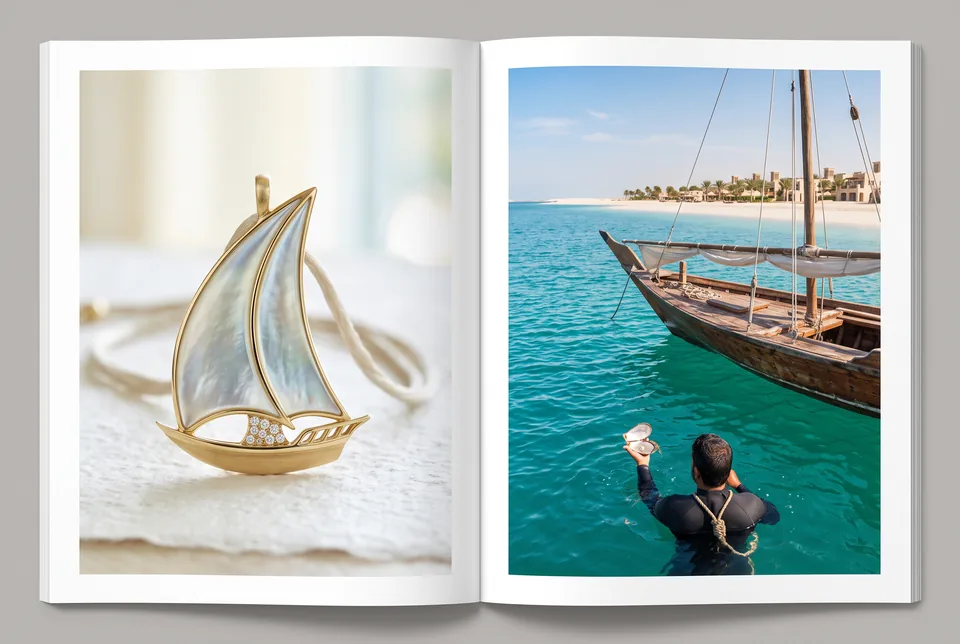
The great diving season, Al Ghus Al Kabir in Arabic, lasted around four months from June to September. During that time the boats stayed out on the banks and the crew lived on board. A diver wore a nose clip made of horn, tied a stone to his foot and let himself be pulled down to the seabed on a rope. His partner on board, the seib, hauled him back up on the rope; hardly anyone could last longer than four minutes. Whoever opened 1,000 oysters found, by the estimate of the historian Robert Carter, one pearl per 50 shells on average, so 20 pearls, and very few of those were round and flawless.
In the 1920s, according to the trade service Rapaport, more than a third of Bahrain's population depended directly on the pearl. Charles Belgrave, adviser to the ruler from 1926, summed up the situation in 1928 in a single sentence.
The prosperity and almost the existence of Bahrain depend on the pearl industry.
Charles Belgrave, 1928, quoted by the Qatar Digital Library
Three blows in twenty years
The first blow came from Japan. Kokichi Mikimoto had presented the first hemispherical cultured pearl in 1893, and from 1916 round cultured pearls were produced in series, as described in the article Mikimoto: how the first cultured pearl came about in 1893. As soon as these pearls reached Europe in the 1920s, prices for small natural pearls fell, because the eye could barely tell the two apart. Bahrain responded in 1928 with a public proclamation: the sale, offering and possession of cultured pearls for commercial purposes were banned. The ban remains in force; private individuals may merely own cultured pearls.
The second blow was the stock market crash of 1929. The buyers in New York and Paris stayed away, and the princes of India tightened their belts. The third blow came on 2 June 1932, when the first oil on the Arabian side of the Gulf shot out of the ground at Jebel Al Dukhan at 400 barrels an hour. The Bahrain Petroleum Company, by its own account, became a reliable employer for Bahrainis affected by the end of the pearl trade; in 1936 the refinery was running at 10,000 barrels a day. Oil work was year-round, pearl diving was seasonal and mostly financed on credit. According to Rapaport, income from pearls fell by around 70 per cent.
Bahrain's population fell from around 100,000 to 90,000 between 1908 and 1941 as diving families moved away. In 1947/48 India, the most important buyer, blocked the import of pearls. By around 1950, according to the Qatar Digital Library, the traditional fishery had all but disappeared.
What remains of the pearl economy
In June 2012 UNESCO inscribed the site Pearling, Testimony of an Island Economy on the World Heritage List. It comprises 17 buildings in the old town of Muharraq, three oyster beds in the sea named Hayr Shtayyah, Hayr Bu Amamah and Hayr Bu-l-Thamah, a stretch of coast at the southern tip of the island and the fort Qal'at Bu Mahir, from which the boats once set sail. The core zone covers 35,086 hectares, the buffer zone 95,876 hectares. UNESCO calls the site the only complete testimony to a pearling culture from the time before the cultured pearl.
The ban of 1928 had a side effect: Bahrain needed a laboratory that could separate natural pearls from cultured ones beyond doubt. In 1990 the Pearl and Gem Testing Laboratory was created by decree within the Ministry of Commerce, and in 2017 it was absorbed into the Bahrain Institute for Pearls and Gemstones, DANAT for short. According to Rapaport, the institute tests over 3 million pearls a year using X-ray and spectroscopy. Anyone who owns an inherited necklace of Gulf pearls will find the routes to an appraisal under inherited pearls: how to have them valued.
The return of the divers
Since 2017 Bahrain has once again been issuing diving licences for the pearl banks. Rapaport cites around 3,000 licensed divers, and in 2025 the UN reported more than 1,000 who are regularly active. They now dive with compressed air and stay underwater for an hour instead of four minutes. The yield remains tiny: about 7 kilograms of natural pearls come out of Bahraini waters each year, and worldwide, according to Rapaport, natural pearls make up just 0.2 per cent of the pearl supply. That is precisely where their value lies.
| Feature | around 1905 | since 2017 |
|---|---|---|
| Divers | over 17,500 | 1,000 to 3,000 with a licence |
| Diving technique | nose clip, stone, rope | compressed air |
| Time underwater | up to 4 minutes per dive | up to 1 hour |
| Season | 4 months, June to September | possible all year round |
| Authenticity testing | the merchant's eye and experience | DANAT, over 3 million pearls a year |
| Cultured pearls in trade | not yet an issue, banned from 1928 | still banned |
What the end of the Gulf pearl means for buyers now
Practically every natural pearl necklace that appears at auction was fished before 1930. New supply arrives in grams, not tonnes. Anyone buying natural pearls looks for three things: a laboratory certificate with X-ray evidence, the oyster species Pinctada radiata named, and a description of provenance that fits the era before the cultured pearl. In 1928 Bahrain decided never to mix natural and cultured pearls. The market would do well to follow suit.
Frequently asked questions
Why were pearls from the Persian Gulf considered the finest in the world?
On the shallow, salt-rich banks off Bahrain, the oyster Pinctada radiata forms pearls with very fine, creamy white nacre and a faint pink shimmer. Around 1905, 97.3 per cent of the Gulf's pearl turnover passed through Bahrain, and dealers in Paris, Bombay and New York sourced their best strands from there.
When did pearl diving in Bahrain end?
The decline began in the 1920s with Japanese cultured pearls, worsened with the stock market crash of 1929 and the discovery of oil on 2 June 1932. By around 1950 the traditional fishery had practically disappeared.
Are cultured pearls really banned in Bahrain?
Yes. Since a proclamation of 1928, cultured pearls may not be sold, offered or held for commercial purposes in Bahrain. The ban is still in force; private individuals may merely own cultured pearls.
How many people in Bahrain lived off the pearl?
In 1905, 917 boats with more than 17,500 men sailed from Bahrain; in 1925 there were still over 500 boats with around 15,000 divers. In the 1920s more than a third of the population depended directly on pearl diving.
What is DANAT and what does the institute test?
DANAT is the Bahrain Institute for Pearls and Gemstones, founded in 2017 as the successor to a state laboratory dating from 1990. According to Rapaport, it examines over 3 million pearls a year by X-ray and spectroscopy to determine whether they are natural or cultured.
Can you still buy natural pearls from Bahrain?
Yes, but only in very small quantities. Around 7 kilograms of natural pearls come out of Bahraini waters each year, and worldwide natural pearls account for about 0.2 per cent of supply. Any purchase should come with a laboratory certificate.
Sources
- History of Pearling Pearling Path, Bahrain Authority for Culture and Antiquities
- Divers are a Pearl's Best Friend: Pearl Diving in the Gulf 1840s to 1930s Qatar Digital Library
- Bahrain's Economy: Buffeted between Pearls and Oil Qatar Digital Library
- Pearling, Testimony of an Island Economy UNESCO World Heritage Centre
- Bahrain Looks to Put Natural Pearls on the Map Rapaport
- Bahrain's Pearls: Preserving a Heritage Rapaport
- Pearl Power Rapaport
- Bahrain's pearl divers keep a millennia-old tradition alive UN News
- History of DANAT Bahrain Institute for Pearls and Gemstones
- Bapco History Bahrain Petroleum Company
- Three Large Natural Hollow Pinctada radiata Pearls GIA, Gems & Gemology
- Mansion Cartier
- Cartier Building Wikipedia
- Pearling, Testimony of an Island Economy Wikipedia