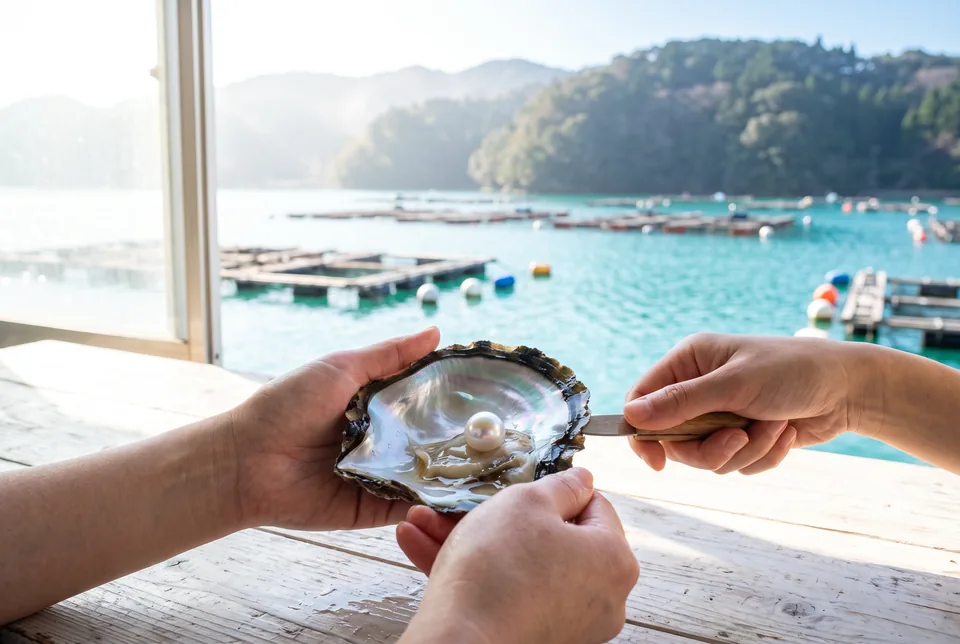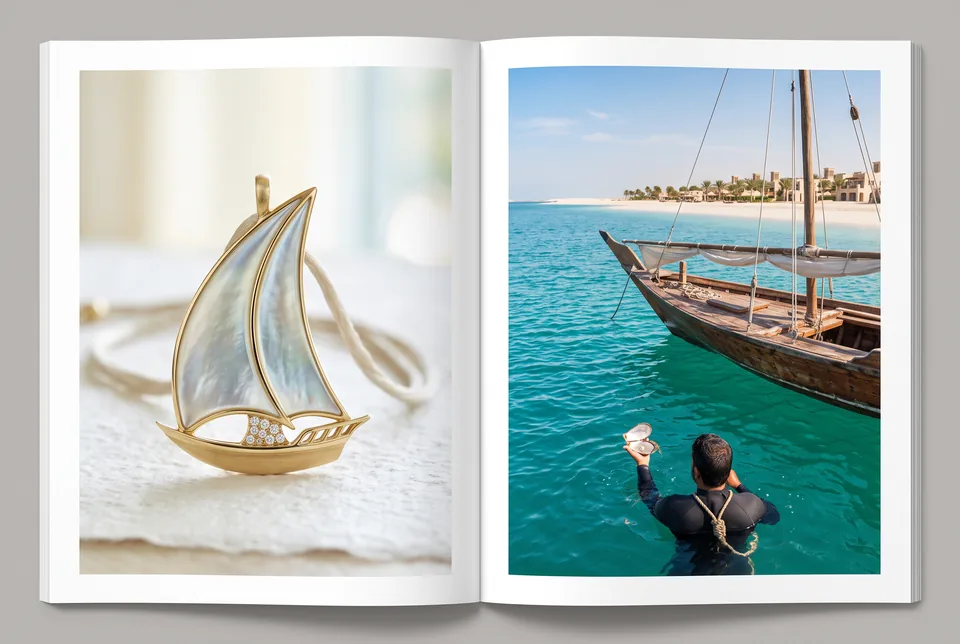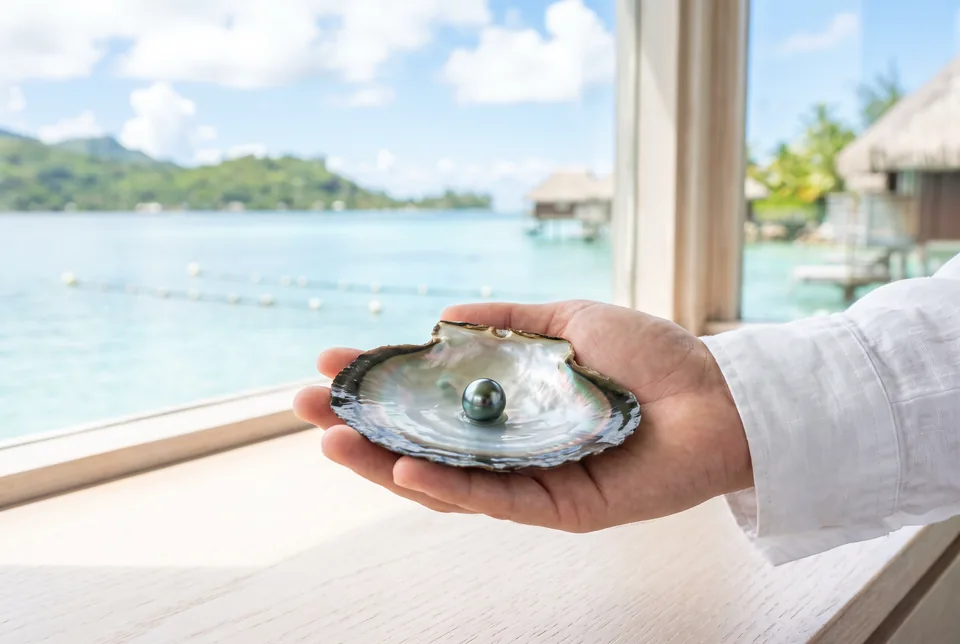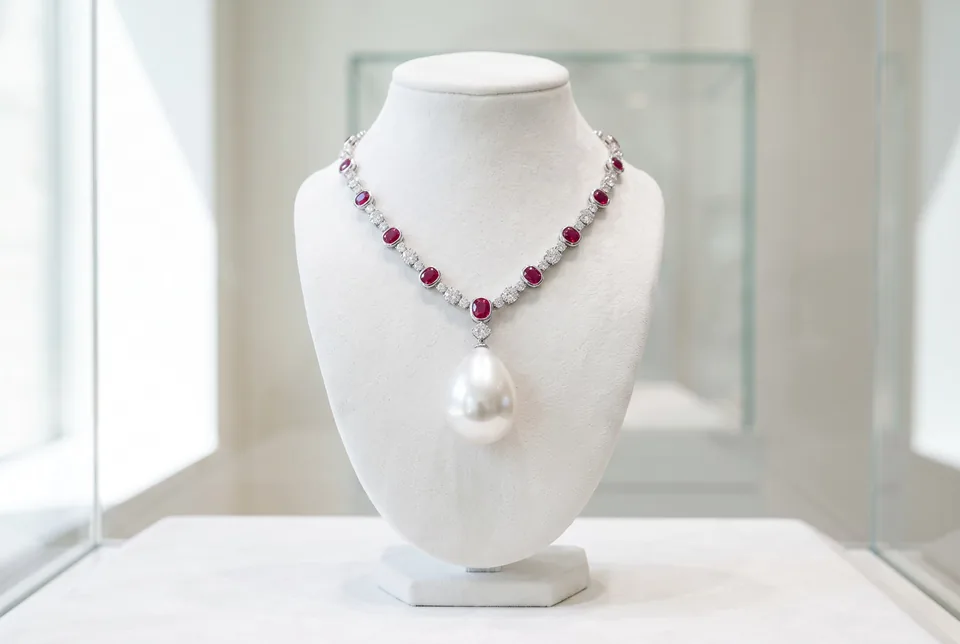
Both records have something in common: they are natural pearls, formed in the mollusc without any human intervention, and both carry a history that can be traced over centuries. It is this combination of rarity and provenance that drives the prices, not size alone. The ranking shows which pieces sold when and where, and the story of La Peregrina explains why a pearl found in 1513 fetched 320 times its 1969 purchase price in 2011.
The ranking of auction records
Four pieces stand at the top of all publicly documented pearl auctions. They come from three centuries, were sold in Geneva, New York and Hong Kong, and share one feature: they are natural pearls with documented provenance. Two of the four pieces far exceeded their estimates; Marie Antoinette's pendant sold for around 18 times its upper estimate.
| Piece | Year | Auction house | Hammer price | Notable feature |
|---|---|---|---|---|
| Marie Antoinette's pearl pendant | 2018 | Sotheby's Geneva | CHF 36,427,000, around USD 36 million | Drop-shaped natural pearl with diamond bow, smuggled out of Paris in 1791 |
| La Peregrina (Elizabeth Taylor) | 2011 | Christie's New York | USD 11,842,500 | Pear-shaped natural pearl from 1513, around 50.6 carats, necklace by Cartier |
| Baroda Pearls | 2007 | Christie's New York | USD 7,096,000 | Two-strand necklace, 68 natural pearls of 9.47 to 16.04 mm |
| Cowdray Pearls | 2015 | Sotheby's Hong Kong | USD 5,266,667 | Single-strand necklace, 42 grey natural pearls, setting by Cartier |
| Marie Antoinette's three-strand pearl necklace | 2018 | Sotheby's Geneva | CHF 2,295,000 | Natural pearls, restrung in the late 19th century, diamond clasp added later |
The prices are hammer prices including buyer's premium, in other words the amount the buyer pays to the auction house. Conversions into euros shift with the daily exchange rate, so the original currency of each sale is given here.
Marie Antoinette's pendant
The piece is simply constructed: a large drop-shaped natural pearl suspended from a diamond bow and an oval diamond. It originally served as the clasp of a three-strand pearl necklace. Ahead of the sale Royal Jewels from the Bourbon Parma Family, Sotheby's estimated it at 1 to 2 million francs; all ten of the queen's pieces together were estimated at 1.6 to 2.9 million francs. After a 14-minute bidding battle the hammer fell at 32 million francs, and with premium the price came to 36,427,000 francs, a new record for a natural pearl.
The provenance explains the premium. The pendant is among the jewels packed at night in 1791 as the royal couple prepared to flee the Tuileries Palace. The pieces made their way to Brussels and on to Vienna, where they remained in the House of Bourbon-Parma for more than 200 years. The ten jewels from the queen's collection brought a combined 43.1 million francs, and the whole sale reached 53.5 million francs. Not a single lot went unsold.
Five centuries on the move with La Peregrina
La Peregrina, Spanish for the pilgrim or the wanderer, was found in 1513 off the Pearl Islands in the Gulf of Panama. An enslaved diver brought it ashore, and the administrator Pedro de Temez sent it to the Spanish court. At the time the pearl weighed 223.8 grains, which is 55.95 carats or 11.2 grams; a grain is the old unit of weight for pearls and equals a quarter of a carat. After drilling and cleaning in 1913 around 204 grains remained; in 2011 Christie's gave the weight as 202.24 grains, around 50.6 carats.
Philip II gave the pearl to his bride Mary I of England in 1554. After her death it returned to Spain and remained in the crown inventory for around 250 years. Joseph Bonaparte took it during his reign from 1808 to 1813, left it to Napoleon III, who sold it in exile to James Hamilton, Duke of Abercorn. The Hamilton family kept the pearl until 1969. Over those centuries it was a wedding gift, a crown jewel, spoils of war and an emergency fund, and every stage is documented. That is rare for pearls and accounts for a large part of its value.
From USD 37,000 to USD 11.8 million
In 1969 La Peregrina came under the hammer at Sotheby's London. Richard Burton bought it for USD 37,000 and gave it to Elizabeth Taylor for Valentine's Day. Taylor commissioned Cartier to make a necklace of natural pearls, rubies and diamonds with the pearl as its pendant. In this setting it became the most famous piece of pearl jewellery of the 20th century.
After Taylor's death, Christie's New York auctioned her collection. On the evening of 13 December 2011, La Peregrina appeared in the catalogue with an estimate of 2 to 3 million US dollars. After four and a half minutes the hammer price stood at USD 11,842,500, the world record for a pearl jewel until 2018. The first 80 lots of the collection brought more than USD 115 million in total. Measured from the 1969 purchase price, the value rose 320-fold in 42 years, though part of that is down to the Cartier necklace and the Taylor name.
The Baroda Pearls and the Cowdray Pearls
With necklaces, what counts is how well the pearls match, not a single stone. The Baroda Pearls come from a seven-strand necklace assembled by Maharaja Khande Rao Gaekwad between 1856 and 1870. For the sale at Christie's New York on 25 April 2007, two strands of 68 pearls were formed from the best rows, 33 on the inner strand and 35 on the outer, diameters 9.47 to 16.04 mm, joined by a diamond clasp by Cartier. Together with a brooch, a pair of earrings and a ring, the ensemble fetched USD 7,096,000, within its estimate of 7 to 9 million.
The Cowdray Pearls are smaller, but their colour is almost without comparison: 42 natural grey saltwater pearls, set by Cartier, from the collection of Viscountess Cowdray (1860 to 1932). The necklace was sold at Sotheby's London in 1937 and came under the hammer again at Christie's London on 13 June 2012 with only 38 pearls, for around USD 3.35 million. It was then restrung to its original 42 pearls using the pearls from a pair of earrings and two further natural pearls, and on 7 October 2015 it fetched USD 5,266,667 at Sotheby's Hong Kong against an estimate of 4.5 to 7 million US dollars, a record for grey natural pearls and a gain of roughly USD 2 million in three years.
Why natural pearls fetch such prices
All five pieces in the table consist of natural pearls. Since cultured pearls took over the market from the 1920s onwards, hardly any new natural pearls have come into trade; what is auctioned comes from old collections. The difference can be proven in the laboratory: a natural pearl has no inserted nucleus, and the X-ray image shows concentric layers all the way to the centre. What this means for buying and valuation is explained in Natural or cultured pearl.
The second price driver is provenance, the unbroken chain of owners. Marie Antoinette's pendant was estimated at 1 to 2 million francs and sold for 36.4 million. The difference is the price of history. Whether a rule for your own purchase can be drawn from that is examined in Are pearls a worthwhile investment?
What the records mean for an ordinary purchase
The records play in a league of their own. Even the CHF 2,295,000 for the queen's three-strand necklace lies far above anything asked for natural pearls in the trade. Anyone who still uses the figures as a yardstick looks at three things: the type of pearl, the condition of the surface and the documentation. Major auction houses publish both estimate and hammer price, and the gap between the two shows how much the market pays for history. Among the four record pieces, the range ran from about 0.8 of the upper estimate for the Baroda Pearls (7.1 million against 7 to 9 million) and the Cowdray Pearls (5.3 million against 4.5 to 7 million), to almost four times for La Peregrina, and to around 18 times for Marie Antoinette's pendant.
Frequently asked questions
Which pearl is the most expensive in the world?
Marie Antoinette's pearl pendant holds the record. Sotheby's Geneva sold it on 14 November 2018 for 36,427,000 Swiss francs, around USD 36 million, against an estimate of 1 to 2 million francs. It is a drop-shaped natural pearl suspended from a diamond bow.
How much is La Peregrina worth today?
The last documented price dates from 13 December 2011: USD 11,842,500 at Christie's New York. The pearl has been in private hands since then and no new sale is recorded. Any current figure is therefore an estimate.
Why did Elizabeth Taylor's pearl cost so much?
La Peregrina is a natural pearl of around 50.6 carats found in 1513, with an unbroken provenance through Spanish kings, the Bonapartes and the British aristocracy. Add to that the Cartier necklace and the Taylor name. The estimate was 2 to 3 million US dollars, and the hammer price came to almost four times the upper limit.
What is the most expensive pearl necklace in the world?
The Baroda Pearls: two strands with 68 natural pearls of 9.47 to 16.04 mm, sold on 25 April 2007 at Christie's New York for USD 7,096,000. The most expensive single-strand necklace is the Cowdray Pearls with 42 grey natural pearls, USD 5,266,667 at Sotheby's Hong Kong on 7 October 2015.
Where was La Peregrina found?
The pearl was found in 1513 off the Pearl Islands in the Gulf of Panama and sent to the Spanish court by the administrator Pedro de Temez. It originally weighed 55.95 carats and was the largest known pearl of its day.
What did Richard Burton pay for La Peregrina?
Richard Burton bought the pearl at Sotheby's London in 1969 for USD 37,000 and gave it to Elizabeth Taylor for Valentine's Day. 42 years later it fetched USD 11,842,500, 320 times as much.
Sources
- Marie Antoinette's Pearls Break Auction Records in Geneva Sotheby's
- Marie Antoinette's pearl pendant sells for record $36 million CBS News
- Rekordpreis bei Genfer Auktion: 36,4 Millionen Franken für einen Perlenanhänger SRF
- Results of Elizabeth Taylor's record-breaking jewels auction New York The Jewellery Editor
- La Peregrina, legendary pearl from Elizabeth Taylor's collection Antiques and Art Ireland
- Most expensive pearl Guinness World Records
- La Peregrina pearl Wikipedia
- Baroda Pearl Necklace Internet Stones
- Sotheby's Hong Kong to Auction Legendary Cowdray Pearls JCK
- The record-breaking Cowdray pearls sell for $5.3m at Sotheby's The Jewellery Editor