No name stands for the cultured pearl quite like Mikimoto. The record, however, has more voices in it than the company logo suggests: a professor of zoology, a carpenter and a marine biologist can claim at least as much credit for the round pearl. The invention set off a price collapse that, on a single day in 1930, wiped out 85 per cent of the value of natural pearls in the Paris trade.
A merchant's son from Toba and a professor from Tokyo
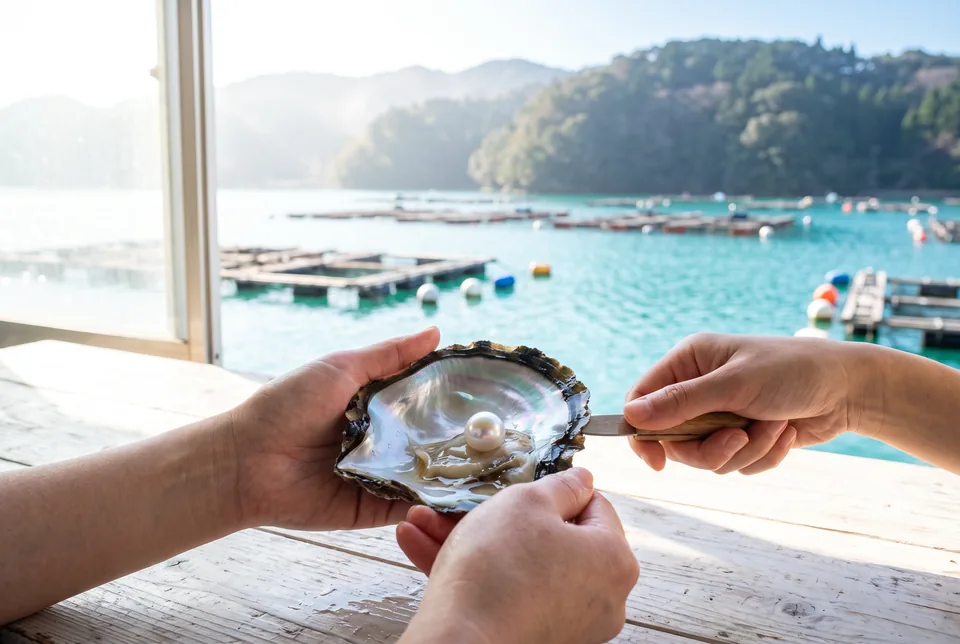
Kokichi Mikimoto was born on 25 January 1858 in Toba, a harbour town on the coast of Mie Prefecture. His father ran a noodle shop. The son first traded in seafood, and in doing so watched the Akoya oyster (Pinctada fucata martensii), Japan's small pearl oyster, come close to vanishing under the hunt for natural pearls. By the late 1880s the observation had become a plan: if pearls can no longer be found, they will have to be grown.
The decisive moment was a meeting in 1890. Kakichi Mitsukuri, professor of zoology at the Imperial University of Tokyo and first director of the Misaki Marine Station, explained the pearl sac theory to Mikimoto: a pearl forms when epithelial cells of the mantle, the layer of skin that also builds the shell, form a pocket inside the oyster's body and deposit nacre within it. The German anatomist Theodor von Hessling had set out this theory as early as 1856. Mikimoto had already begun farming oysters in Ago Bay in September 1888; after his visit to Mitsukuri he inserted the first foreign bodies into the animals there. He had no degree, but he had a professor.
11 July 1893 and the first half pearl
The early years were a run of failures. Mikimoto placed foreign bodies of every kind in the oysters, tried different insertion points, and in November 1892 lost his entire experimental stock in Ago Bay to a red tide, a toxic algal bloom. Rescue came from a second test site: the island of Ojima in Toba Bay, known today as Mikimoto Pearl Island. There, on 11 July 1893, the first half-round cultured pearls were found, grown against the inside of the shell.
The method was simple: a nucleus of mother-of-pearl placed between mantle and shell, which the oyster then covers layer by layer. The result is a half pearl, now called a mabe. Mikimoto was granted Japanese patent no. 2670 for it in 1896. On 26 October 1893 he opened his farm on the island of Tatoku in Ago Bay, and in 1899 he sold jewellery set with half pearls for the first time in Tokyo's Ginza district. The shop on that site is still trading today.
Red tide and the first round pearl in 1905
A half pearl is no substitute for a natural pearl. Mikimoto wanted the free, round pearl, and in 1902 he brought in the former dentist Otokichi Kuwabara to build the tools for it. By 1905 the stock had grown to more than a million oysters. Then, from 10 January into March 1905, the next red tide arrived and killed 850,000 of them, four fifths of the stock.
Among the survivors that had been operated on that same year, a handful of fully round pearls turned up unexpectedly. With these as proof, Mikimoto filed the so-called Meiji method in 1907, granted as patent no. 13673 in 1908. The yield, however, was so low that no production could be built on it. The round cultured pearl had been found in 1905, but it had not yet been invented.
Mise and Nishikawa, the forgotten inventors
The solution came from two directions at once. Tatsuhei Mise, a carpenter from the village of Matoya in Mie, had according to the GIA already implanted nuclei of lead and silver into around 15,000 oysters in 1902 and harvested small round pearls in 1904. In 1907 he filed patent no. 12598 for a needle used to inject a nucleus into the mantle tissue. Tokichi Nishikawa, a marine biologist at the Misaki station, a pupil of Mitsukuri and married since 1903 to Mikimoto's second daughter, had been working on the same question since April 1906 and submitted his applications in October 1907. His finding: a small piece of mantle tissue, placed in the oyster together with a nucleus, forms the pearl sac by itself.
Both had arrived at the same principle: nucleus plus a piece of tissue. They came to an agreement, and their invention has carried both names ever since, the Mise-Nishikawa method. Every round cultured pearl, whether Akoya, South Sea or Tahitian, is still produced on this pattern today, as the article on nucleus and mantle tissue shows. Nishikawa died in 1909 at the age of 35, before a harvest could confirm his success. Mikimoto had agreed with him as early as September 1907 to test the method on around 27,000 oysters, and acquired the rights in 1916.
| Year | Event | People involved |
|---|---|---|
| 1893 | First half-round cultured pearls on Ojima near Toba (11 July), farm opened on Tatoku (26 October), patent no. 2670 granted in 1896 | Mikimoto, Mitsukuri |
| 1899 | First shop in Ginza, Tokyo, selling half pearl jewellery | Mikimoto |
| 1905 | First round pearls among the survivors of the red tide, patent 1908 | Mikimoto, Kuwabara |
| 1907 | Patent applications for nucleus plus mantle tissue, filed independently | Mise, Nishikawa |
| 1916 | Mikimoto acquires the rights to the Mise-Nishikawa method | Mikimoto |
| 1919 | First round cultured pearls on sale in London, 75 per cent of the natural pearl price | Mikimoto |
| 1924 | Paris court: cultured pearls do not differ from natural pearls | Jameson, Boutan as expert witnesses |
The road to Europe and the Paris trial
In 1913 Mikimoto opened a shop in London. From 1918 there were enough round pearls, and in 1919 they reached the London market: at 75 per cent of the price of natural pearls, according to a review by the Swiss foundation SSEF. The trade reacted fiercely. In 1921 a London newspaper called the goods a fake, and the accusation leapt to Paris, where trade associations demanded an import ban.
The dispute ended in court. In what became known as the Paris trial, the biologists H. Lyster Jameson of Oxford and Louis Boutan of Bordeaux testified that cultured and natural pearls do not differ in their formation or structure. In 1924 the French court ruled accordingly. What has remained ever since is the question of value, not of authenticity; the article on natural and cultured pearls pursues it. In 1927, on his journey through the United States, Mikimoto met Thomas Edison.
It is one of the wonders of the world that you were able to culture pearls.
Thomas Edison to Kokichi Mikimoto, 1927, according to Mikimoto's company history
The collapse in natural pearl prices
The figures from the 1920s show how quickly the gap widened. In 1922 the New York Times reported that cultured pearls cost 30 per cent less than natural pearls; by 1928 a fraud case put their value at just one tenth. Natural pearls held on nonetheless: Tiffany sold necklaces for 230,000 and 360,000 dollars in 1923 and 1925. The real crash came with the Great Depression. In 1930 the Bank of France stopped its credit to pearl dealers, and according to the account of the dealer Léonard Rosenthal the value of pearls in the Paris trade fell by 85 per cent that same day.
Cultured pearls became cheap as well. One momme, the Japanese unit of weight equal to 3.75 grams, of 6.3 millimetre Akoya pearls cost 5,000 yen in Japan in 1919 and just 5 yen in 1939. The number of farms rose from 33 with 669,000 oysters in 1926 to 258 with 10,858,000 oysters in 1937. In 1932 Mikimoto publicly burned inferior pearls in front of the Kobe Chamber of Commerce to clean up the market. In the Persian Gulf, the old centre of the natural pearl, almost nothing of the fishery survived; the article on pearl diving in Bahrain tells the story of that ending.
| Year | Price level |
|---|---|
| 1917 | Cartier exchanges a natural pearl necklace worth 1 million dollars for a mansion on Fifth Avenue in New York |
| 1919 | Round cultured pearls in London at 75 per cent of the natural pearl price, 1 momme of Akoya (6.3 mm) in Japan 5,000 yen |
| 1922 | Cultured pearls 30 per cent below natural pearls (New York Times) |
| 1930 | Natural pearls lose 85 per cent in one day after the Bank of France halts credit |
| 1939 | 1 momme of Akoya (6.3 mm) in Japan 5 yen |
What remains of 1893
Mikimoto died on 21 September 1954 at the age of 96. His contribution is the industry: he turned a laboratory result into a product, with shops in Ginza, London (1913) and Paris (1928), and he saw the Paris trial through. The technique belongs to Mise and Nishikawa, the theory to von Hessling and Mitsukuri. Anyone wearing an Akoya necklace today wears the result of that collaboration: a nucleus of shell, a piece of mantle tissue and the patience an oyster needs.
Frequently asked questions
Who invented the cultured pearl?
The first cultured pearl was harvested by Kokichi Mikimoto on 11 July 1893, although it was a half-round pearl grown against the shell. The method for round cultured pearls, nucleus plus mantle tissue, was filed independently in 1907 by Tatsuhei Mise and Tokichi Nishikawa. Mikimoto bought the rights in 1916 and built an industry on them.
What is the Mise-Nishikawa method?
A round nucleus of shell and a small piece of mantle tissue from a donor oyster are placed in the gonad of the pearl oyster. The tissue forms a pearl sac that coats the nucleus with nacre. Every round cultured pearl, whether Akoya, South Sea or Tahitian, has been produced on this principle since 1907.
When was the first round cultured pearl produced?
In 1905, after a red tide that killed 850,000 oysters in Ago Bay between 10 January and March. A few fully round pearls were found among the survivors. Round cultured pearls were not sold until 1919 in London, because the yield of the early method was too small.
Why did natural pearls fall so sharply in value after 1930?
The Great Depression hit the luxury market, and in 1930 the Bank of France halted its credit to pearl dealers. According to the account of the dealer Léonard Rosenthal, pearls in the Paris trade lost 85 per cent of their value that same day. Cultured pearls from Japan already cost only a tenth of natural pearls by then.
Are Mikimoto pearls natural pearls?
No. Mikimoto has sold cultured pearls since 1899, at first half pearls and since 1919 round Akoya pearls. A Paris court found in 1924 that cultured pearls do not differ from natural pearls in their formation or structure.
Sources
- A History of the Cultured Pearl Industry, Zoological Science 30(10), 783 to 793 Kiyohito Nagai, Zoological Society of Japan, 2013
- The Value of Pearls: A Historical Review and Current Trends Sato and Cartier, SSEF Swiss Gemmological Institute, GemGuide 2022
- History of Cultured Pearls, Part 1 GIA Gemological Institute of America
- Mikimoto, Kokichi Lang Antiques, Antique Jewelry University
- Brand Story Mikimoto
- Kokichi Mikimoto Wikipedia
- Mikimoto (company) Wikipedia