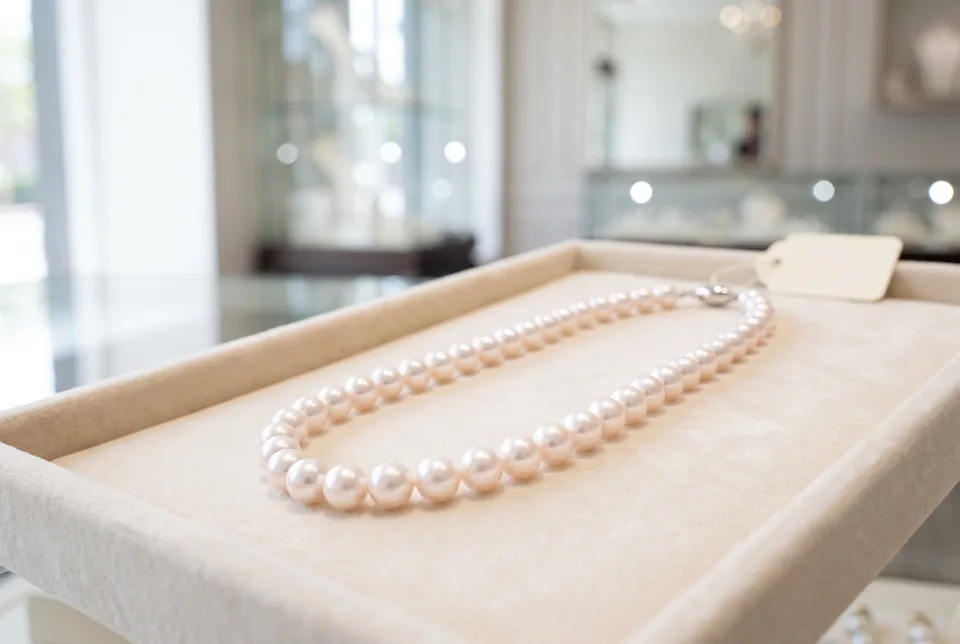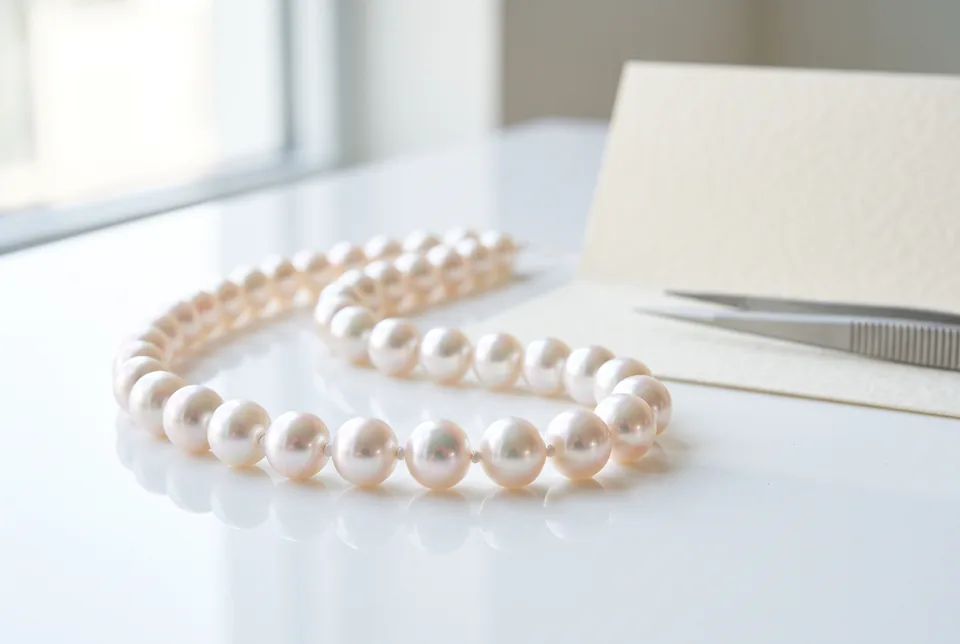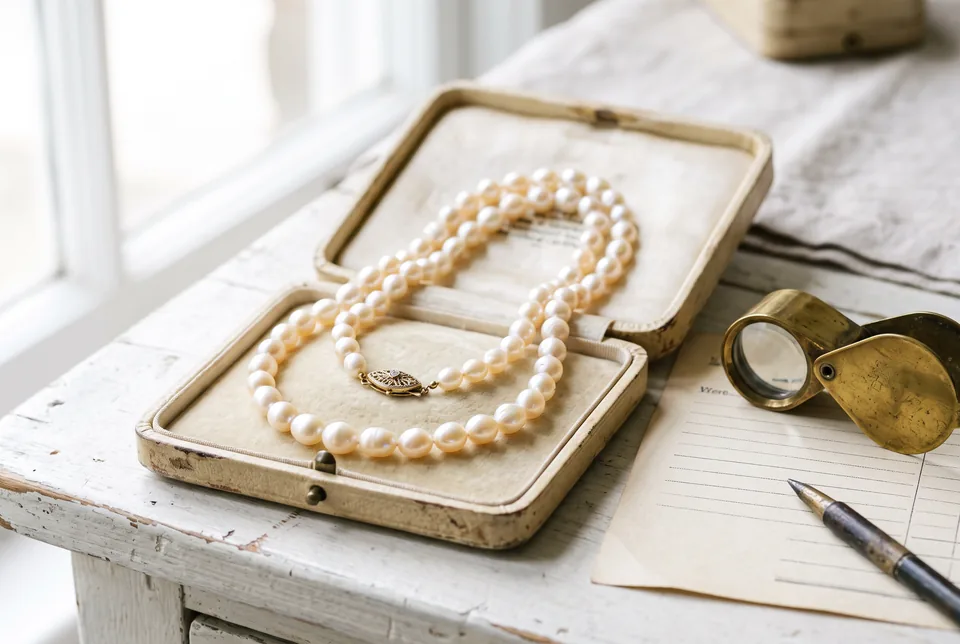
A pearl necklace from an estate is a memory, an asset and sometimes a question for the tax office. Which level of examination makes sense depends on what is to happen with the piece: wearing, insuring, selling or declaring it.
The first look at the jeweller
A specialist shop with experience in pearls is the simplest route. Within minutes a jeweller can tell whether the pearls are saltwater or freshwater cultured pearls, what condition the surface is in and whether the necklace needs restringing. This assessment is usually free and verbal, but it is no evidence for an insurer or an authority.
The jeweller is also a potential buyer, and that colours the figure. The master goldsmith Heinrich Butschal describes in his jewellery forum how dealer offers for necklaces with small pearls often amount to no more than the gold value of the clasp; in a post from 2016 he put that at EUR 30 to 80. For pearls from about 7.5 mm he sees demand as stable to rising, and the gap between a quick dealer offer and a fair market price can run to four figures. Anyone who wants to sell should get a second opinion first, see How to Tell Real Pearls: 6 Tests That Work at Home.
Some appraisers also offer online assessments: from at least three photographs, a fixed fee of EUR 25 buys a written classification within 48 hours.
The publicly appointed and sworn expert
The second stage is the publicly appointed and sworn expert, in German ö.b.u.v.: examined by a chamber of industry and commerce and sworn to give impartial opinions. The German register at svv.ihk.de lists around 8,000 entries, about 20 of them for jewellery, gems and pearls.
Such a valuation describes the piece with photographs, measures size and weight, determines pearl type, colour, lustre and surface, examines the clasp and states a value for a defined purpose: replacement value for insurance or market value for probate. Fees depend on the time spent; hourly rates run from roughly EUR 160 to 230 plus expenses. Rule of thumb: a three figure sum for a single necklace, a free preliminary consultation, about two to three weeks.
What the expert cannot achieve with loupe and microscope is the certain separation of natural from cultured pearl.
The laboratory and the X-ray
A natural pearl forms without human intervention, a cultured pearl grows around an inserted bead or piece of tissue. From the outside both look the same. Only an X-ray sees the difference: the bead of a cultured pearl appears as a sharply defined sphere, a natural pearl shows concentric growth rings to the centre. Why this multiplies the price: Natural or Cultured Pearl: The Difference and Why It Counts.
Microradiography is the most reliable non-destructive way of seeing the internal structure of pearls.
Gemological Institute of America (GIA), Analysis and Grading FAQ
In Germany the Deutsche Stiftung Edelsteinforschung (DSEF) in Idar-Oberstein offers this examination. Its price list dated 1 January 2025 quotes, for a strand under 10 mm, EUR 150 for a verbal finding, EUR 250 for a short written finding and EUR 350 for the full report; from 10 mm the figures are EUR 250, 350 and 450. A single pearl costs EUR 100 to 180, each additional strand EUR 50 to 80, all plus VAT. Express service within three working days costs 50 percent more.
The GIA charges at its pearl laboratory in Bangkok by strand length and largest pearl diameter: under the fee schedule effective 1 July 2026, a Pearl Identification Report for a strand of up to 25 inches with pearls of 5 to 8 mm costs 9,780 baht, from 8.01 mm 13,040 baht, roughly EUR 250 to 350.
The levels of examination compared
| Level | Cost | What it establishes | Turnaround |
|---|---|---|---|
| Jeweller, visual inspection | usually free | pearl type, condition, purchase offer; no evidence | immediate |
| Short online assessment from photographs | EUR 25 fixed fee | rough classification | 48 hours |
| Sworn expert, written valuation | roughly EUR 160 to 230 per hour, three figures per necklace | value for insurance, probate, court; no certain natural/cultured separation | 2 to 3 weeks |
| DSEF laboratory, verbal finding (strand under 10 mm) | EUR 150 plus VAT | natural or cultured, treatment; no monetary value | by arrangement, express 3 working days (+50%) |
| DSEF laboratory, full report (strand under 10 mm) | EUR 350 plus VAT | X-ray finding as a document; no monetary value | by arrangement, express 3 working days (+50%) |
| GIA Pearl Identification Report, strand 5 to 8 mm | 9,780 baht, roughly EUR 250 | natural/cultured, mollusc species, treatment; no monetary value | standard schedule, express 48 hours |
The sequence is not compulsory. A necklace of 6 mm cultured pearls with a silver clasp needs no X-ray for EUR 350. A piece from before the 1920s with irregular, slightly baroque pearls and an old platinum clasp should go to the laboratory before any talk of selling. Current prices: How Much Does a Pearl Necklace Cost? 2026 Prices by Pearl Type.
The Akoya necklace from the estate
Many estates contain a single-strand necklace of white, very round pearls of 6 to 7 mm, usually Japanese Akoya cultured pearls from the post-war decades. The disappointment at the jeweller has a material cause: the thickness of the nacre, the layer the oyster deposits around the inserted bead. The benchmark for thick nacre in Akoya pearls is 0.25 mm, and much commercial stock falls short of it. With thin nacre the bead shows through and the pearl looks chalky; at points of friction it may be worn down to the bead. An expert spots this at the drill hole, the laboratory measures it on the X-ray. The advice then is to wear the necklace rather than sell it.
Inheritance tax on inherited pearls
The German Inheritance Tax Act (ErbStG) exempts household effects up to EUR 41,000 when a spouse, children or grandchildren inherit (tax class I), and other movable items up to EUR 12,000; for all other heirs a combined EUR 12,000 applies. Pearls are expressly excluded: section 13 paragraph 1 number 1 ErbStG removes means of payment, securities, coins, precious metals, gemstones and pearls from this exemption. An inherited pearl necklace therefore counts at full market value. In practice this rarely matters, because the personal allowances under section 16 ErbStG come first.
| Heir | Allowance |
|---|---|
| Spouse, registered civil partner | EUR 500,000 |
| Children, stepchildren, children of deceased children | EUR 400,000 |
| Grandchildren | EUR 200,000 |
| Parents and grandparents (on inheritance) | EUR 100,000 |
| Siblings, nieces, nephews, all others | EUR 20,000 |
As long as the entire estate, accounts, property and jewellery combined, stays below the allowance, no tax is due. Above it, the market value of the pearls must be declared: the amount a sale would realise, not the retail price. Where the figures are realistic, the tax office normally asks for no evidence. For communities of heirs a written valuation avoids disputes over the division.
From the jewellery case to the valuation
- Define the purpose: wearing, insuring, selling or dividing the estate. That determines the level.
- Gather documents: old receipts, cases with a jeweller's name, photographs of the deceased wearing the jewellery.
- Leave the necklace as it is: no cleaning, no restringing, no removing the clasp. Thread and clasp are clues too.
- Start with a jeweller or an online assessment, then decide whether an expert or a laboratory should follow.
- Tell the expert the purpose (replacement or market value), otherwise the figure will not match the occasion.
- Order a laboratory finding only where natural pearls are suspected or for pearls from about 8 mm.
Frequently asked questions
How much does it cost to have an inherited pearl necklace appraised?
A jeweller's visual inspection is usually free, an online assessment costs EUR 25. A sworn expert charges roughly EUR 160 to 230 per hour, a three figure sum for a necklace. A laboratory finding with X-ray costs EUR 150 to 350 plus VAT per strand in Idar-Oberstein.
Can a jeweller tell whether inherited pearls are natural pearls?
Not with certainty. Natural and cultured pearls look identical from the outside. Only an X-ray in a gemmological laboratory shows whether there is an inserted bead inside or continuous growth rings.
Who issues a recognised valuation for pearl jewellery?
Publicly appointed and sworn experts for jewellery, gems and pearls, examined by a German chamber of industry and commerce; the register at svv.ihk.de lists about 20 of them. Such a valuation is recognised by insurers, courts and tax offices.
Is inheritance tax due on inherited pearls?
Pearls are excluded from the EUR 41,000 household effects allowance and count at market value. Tax becomes due only once the total acquisition exceeds the personal allowance: EUR 500,000 for spouses, EUR 400,000 for children, EUR 200,000 for grandchildren.
How long does a pearl valuation take?
An expert needs about two to three weeks. The laboratory in Idar-Oberstein offers express service within three working days for a 50 percent surcharge, the GIA a 48 hour service.
Why is grandmother's Akoya necklace worth so little?
Usually because of small pearls under 7.5 mm and thin nacre. The benchmark for thick nacre in Akoya pearls is 0.25 mm, and many older necklaces fall below it, so dealers often offer only the gold value of the clasp. Wearing the necklace is then the better course.
Sources
- § 13 ErbStG Steuerbefreiungen Federal Ministry of Justice, gesetze-im-internet.de
- § 16 ErbStG Freibeträge Federal Ministry of Justice, gesetze-im-internet.de
- Price list in euros, valid from 01.01.2025 (pearl examination) Deutsche Stiftung Edelsteinforschung (DSEF), Idar-Oberstein
- Pearl Services Fee Schedule, effective July 1, 2026 Gemological Institute of America (GIA)
- How does GIA identify whether pearls are Natural or Cultured? Gemological Institute of America (GIA)
- The nationwide German register of experts (SVV) Deutsche Industrie- und Handelskammer (DIHK)
- Frequently asked questions on jewellery valuations der-schmuckgutachter.de, publicly appointed and sworn expert
- Private jewellery valuations, process and costs (hourly rate EUR 230 incl. VAT) sachverstand-schmuck.de, jewellery expert
- Jewellery and gemstone valuations (hourly rate EUR 160) berlinerschmuck.de, jewellery expert
- Inheritance tax: valuation of jewellery and art erbrecht-ratgeber.de
- Value of a pearl necklace (heirloom from my grandmother), post dated 07.04.2016 Jewellery forum of Heinrich Butschal, master goldsmith
- Size of the nucleus (Nacre thickness in Akoya) Pearl-Guide.com
- Having jewellery valued, short online assessment estimando.de