Nacre is made of tiny aragonite platelets, around 0.5 micrometres thick and stacked on top of one another like roof tiles. This structure cannot be reproduced with lacquer, and that is exactly what the classic home tests rely on. Anyone who knows what each test reveals and what it misses can get surprisingly far with a tooth, a loupe and a small UV torch.
Why nacre cannot be faked
Every real pearl, whether from the sea or from a farm, is made of nacre. Nacre is a composite of aragonite, a crystalline form of calcium carbonate, and an organic binder. The aragonite crystals take the form of hexagonal platelets, 10 to 20 micrometres wide and around 0.5 micrometres thick. Thousands of these platelets are stacked on top of one another and held together by thin layers of protein. Because the platelet thickness is close to the wavelength of visible light, interference produces the soft, shifting play of colour that gemmologists call orient.
This construction has two consequences that can be checked at home. First, the surface is never perfectly smooth, because the platelet edges protrude microscopically. Second, the material is soft: pearls sit at 2.5 to 4.5 on the Mohs scale, while window glass sits at 5.5. The Mohs scale is a hardness scale on which each material scratches the one below it. An imitation with a glass core is therefore harder than the original it is copying.
The tooth test and the rub test
The tooth test is the best-known trick in the pearl trade. The pearl is drawn lightly across the biting edge of a front tooth. Real nacre feels finely gritty, rather like very fine sandpaper, because the aragonite platelets catch on the enamel. A pearl made of glass or plastic glides smoothly across. Do not bite, and wipe the pearl first so that no grain of sand skews the result.
The rub test builds on this: two pearls from the same strand are rubbed gently against each other. Real pearls offer slight resistance, and a fine white nacre dust is sometimes left on the cloth, which wipes away without harming the pearl. Imitations slide off one another. Both tests reach their limit with top-tier imitations: the well-known Mallorca imitation pearls consist of a white glass core dipped up to 30 times in a pearl essence made from fish scales. Against a tooth, this surface can feel deceptively real. Under magnification it still gives itself away: instead of the layered structure, the lacquer shows a mass of tiny dots.
The drill hole edge
The most telling check without any equipment is a look at the drill hole. On a real pearl the edge is sharp and clean, and inside the hole the layers of nacre appear as fine concentric rings, much like the growth rings of a tree. On a bead-nucleated cultured pearl, a visible transition to the mother-of-pearl bead often lies beneath the layers, a dark line that stands out from the rest. Imitations look different: the lacquer chips away at the drill hole, the rim looks raised or flaky, and glass or a pale plastic core shows through underneath. A 10x loupe is enough for this; on an undrilled pearl the test does not apply.
Weight, coolness and the loupe
Pearls feel heavy for their size and are cool to the first touch, because nacre conducts heat well. A plastic pearl is light and takes on the warmth of the hand at once. This test fails with glass imitations, though: glass is about as heavy as nacre and just as cool. Weight and temperature therefore serve only as a first filter against plastic, not as proof.
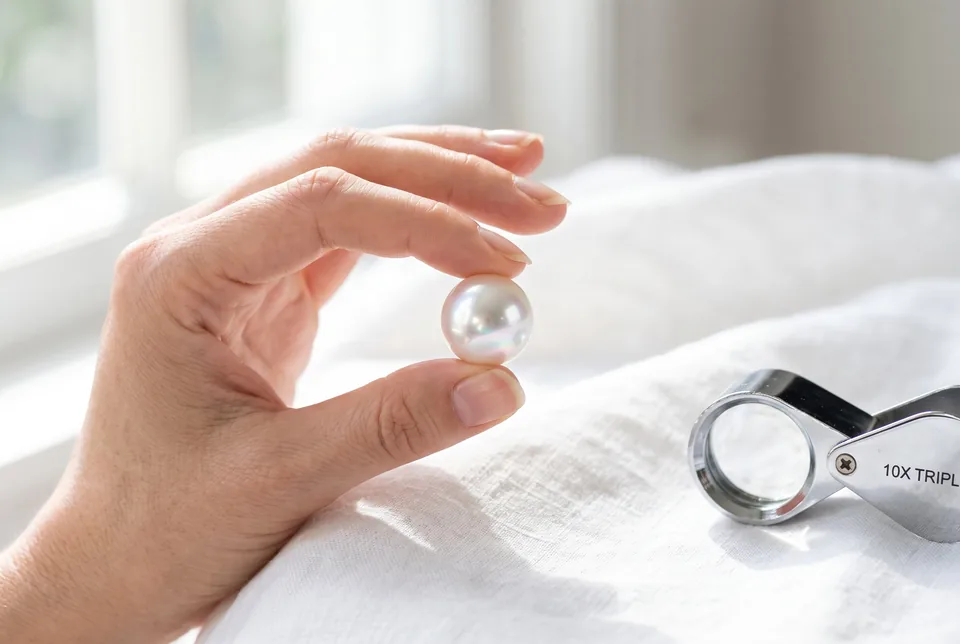
The loupe is more reliable. Pearls grow inside a living animal and so carry small irregularities: tiny pits, fine growth lines, slight variations in shape and colour from pearl to pearl. A perfectly uniform strand is suspicious. Real pearls also show a lustre that seems to come from within, while imitations mostly reflect only at the surface. Anyone wanting to learn where good stops and very good begins will find the criteria in our guide to pearl grades and what they mean.
UV light
A small long-wave UV torch of the kind sold for checking banknotes reveals another difference. White to cream pearls without optical brighteners glow faintly blue to greenish blue under it, with a peak between 480 and 500 nanometres, as a GIA study of 289 Akoya cultured pearls found, of which 139 had been treated with brighteners and 150 had only been bleached. Plastic and glass react differently: they usually stay dark, or glow a harsh white if the lacquer contains brighteners. Such brighteners are also found on treated cultured pearls, however: they shift the glow to 430 to 434 nanometres, a stronger violet-blue. UV light therefore separates plastic from pearl quite well, but says nothing about whether a pearl has been bleached or dyed.
| Test | What it shows | What it does not show |
|---|---|---|
| Tooth test | Rough aragonite structure, separates nacre from smooth glass and plastic | High-end lacquered imitations with up to 30 coats can pass |
| Rub test | Resistance and fine nacre dust on real pearls | Same limit as the tooth test, no verdict on cultured or natural |
| Drill hole edge | Sharp edge, layered nacre, flaking lacquer on imitations | Nothing on undrilled pearls, bead transition visible only with practice |
| Weight and coolness | Separates light plastic pearls from heavy, cool pearls | Glass imitations are about as heavy and cool as nacre |
| Loupe (10x) | Growth lines, pits, irregularity across the strand | No verdict on very clean top qualities |
| UV light (long-wave) | Blue to greenish blue glow on nacre without brighteners | Whether a pearl has been bleached or brightened can only be settled by a spectrometer in the lab |
Where only an X-ray can help
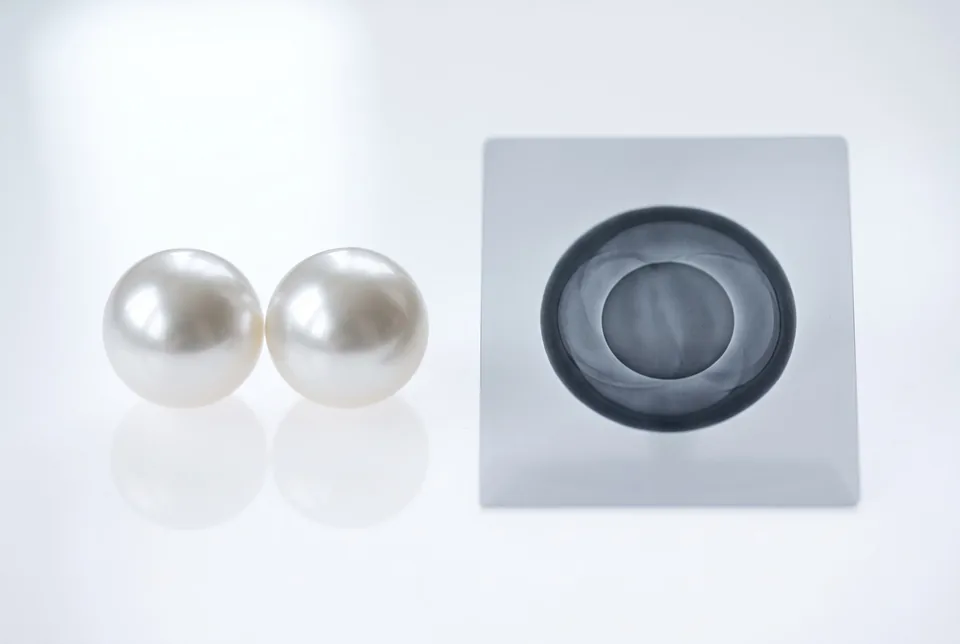
All six tests answer the same question: nacre or imitation. The more valuable question, whether a pearl grew naturally or was cultured, is answered by none of them. The reason lies inside. In an X-ray, a bead-nucleated cultured pearl shows a solid centre without growth rings, while a natural pearl shows concentric rings from the centre outwards. GIA calls microradiography the most reliable non-destructive method for seeing this structure. For difficult cases, such as non-beaded cultured pearls, laboratories have used X-ray computed microtomography since around 2010. This three-dimensional imaging method also reveals small cavities and tissue remnants at the centre. Why this distinction changes the price many times over is explained in natural or cultured pearl.
Under its fee schedule effective 1 July 2026, GIA charges USD 200 for a strand up to 63.5 centimetres (25 inches) long with pearls under 5 millimetres, USD 300 for 5 to 8 millimetres and USD 400 above that, with each further 25.4 centimetres (10 inches) costing USD 100. A single loose pearl up to 2.99 carats costs USD 60, and measuring nacre thickness USD 15 per pearl or USD 75 per strand. The Swiss laboratory SSEF charges CHF 1,000 for a strand with pearls under 10 millimetres, CHF 1,450 for 10 to 13 millimetres, CHF 2,000 for 13 to 16 millimetres and CHF 2,750 above 16 millimetres, all excluding VAT; tomography of a single pearl adds CHF 500, and radiocarbon dating CHF 1,200.
| Laboratory | Strand | Fee | Additional service |
|---|---|---|---|
| GIA | up to 63.5 cm (25 inches), pearls under 5 mm | USD 200 | Nacre thickness USD 75 per strand |
| GIA | up to 63.5 cm (25 inches), pearls 5 to 8 mm | USD 300 | 48-hour express service: USD 350 or 100 per cent of the fee, whichever is lower |
| GIA | up to 63.5 cm (25 inches), pearls from 8.01 mm | USD 400 | each further 25.4 cm (10 inches) USD 100 |
| SSEF | largest pearl under 10 mm | CHF 1,000 | Tomography CHF 500 per pearl |
| SSEF | largest pearl 10 to 13 mm | CHF 1,450 | Radiocarbon dating CHF 1,200 |
| SSEF | largest pearl 13 to 16 mm | CHF 2,000 | each further strand 50 per cent |
| SSEF | largest pearl over 16 mm | CHF 2,750 | Prices excluding VAT |
The right order for testing
- Loupe first: look at the drill hole, the surface and the evenness of the strand, which takes two minutes and exposes most imitations
- Then tooth or rub: confirmation of the nacre structure, wiping the pearl first
- Then UV light: blue to greenish blue argues against brighteners, a strong violet-blue for them
- Weight and coolness only as an extra check against plastic, never as the sole argument
- For heirlooms with pearls over 8 millimetres or of unclear origin, commission a laboratory X-ray before selling or insuring
A pearl that passes two tests and stumbles on the third is usually a good imitation, and that is no fault as long as it was sold as such. Things get harder with an inherited strand whose pearls pass every home test. Then only the question of natural or cultured remains open, and it decides the value. How an appraisal works and what it costs is covered in having inherited pearls appraised.
Lustre comparison
Matte on the left, mirror bright on the right: drag the glass edge. Same strand, only the lustre changes.
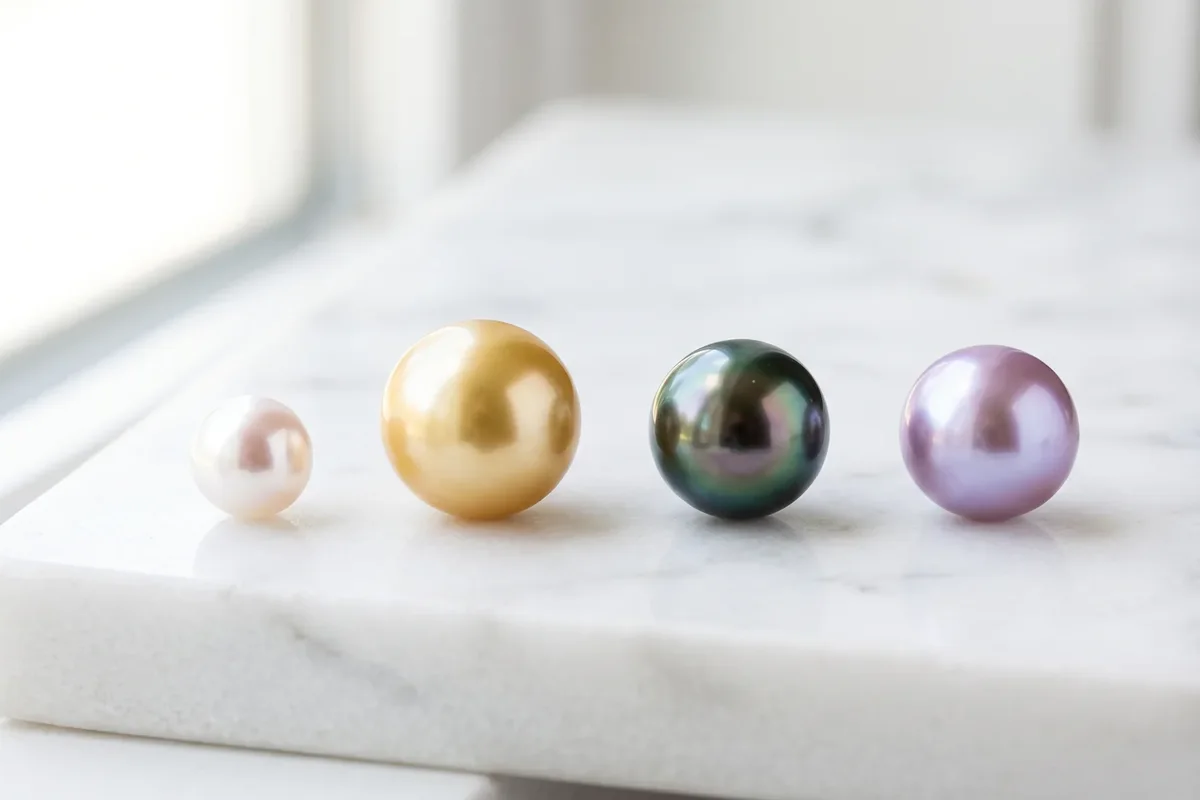 mattemirror
Frequently asked questions
Is the tooth test reliable for pearls?
For simple glass or plastic imitations, yes: real nacre feels finely gritty thanks to its aragonite platelets around 0.5 micrometres thick, while lacquer glides smoothly. High-end imitations with up to 30 coats of lacquer can pass the test, however. That is why a look at the drill hole should always be part of the check.
How do you recognise a real pearl at the drill hole?
The edge is sharp and clean, and inside the hole the nacre layers are visible as fine rings. On imitations the lacquer flakes at the rim and glass or plastic appears underneath. A 10x loupe is enough for this check.
Can pearls be tested with a UV torch?
Yes, with long-wave UV light. White pearls without optical brighteners glow faintly blue to greenish blue with a peak at 480 to 500 nanometres, brightened pearls violet-blue at 430 to 434 nanometres. Plastic usually reacts differently. The test does not show whether a pearl has been bleached.
Can I tell at home whether a pearl is natural or cultured?
No. The difference lies inside the pearl and becomes visible only in an X-ray: bead-nucleated cultured pearls show a solid centre, natural pearls concentric growth rings. Laboratories such as GIA and SSEF use microradiography and X-ray computed microtomography for this.
How much does laboratory testing of a pearl necklace cost?
At GIA, a strand up to 63.5 centimetres (25 inches) costs USD 200 to 400 depending on pearl size, under the fee schedule effective 1 July 2026. SSEF charges CHF 1,000 to 2,000 per strand, tiered by the largest pearl diameter, and CHF 2,750 above 16 millimetres. GIA tests a single loose pearl from USD 60.
Are Mallorca pearls real?
No, they are imitations of high manufacturing quality. They consist of a glass core dipped up to 30 times in an essence made from fish scales. Against a tooth they can deceive, but under a loupe the lacquer shows tiny dots instead of the layered structure of nacre.
Sources
- Nacre Wikipedia
- Pearl Wikipedia
- Mohs scale Wikipedia
- How does GIA identify whether pearls are Natural or Cultured? GIA
- X-ray Computed Microtomography: Distinguishing Natural Pearls from Beaded and Non-Beaded Cultured Pearls GIA Gems & Gemology
- Optical Whitening and Brightening of Pearls: A Fluorescence Spectroscopy Study GIA Gems & Gemology
- Pearl Services Fee Schedule (US Dollar), effective July 1, 2026 GIA
- Testing prices SSEF Swiss Gemmological Institute
- Mallorca Perlen Perlenforum