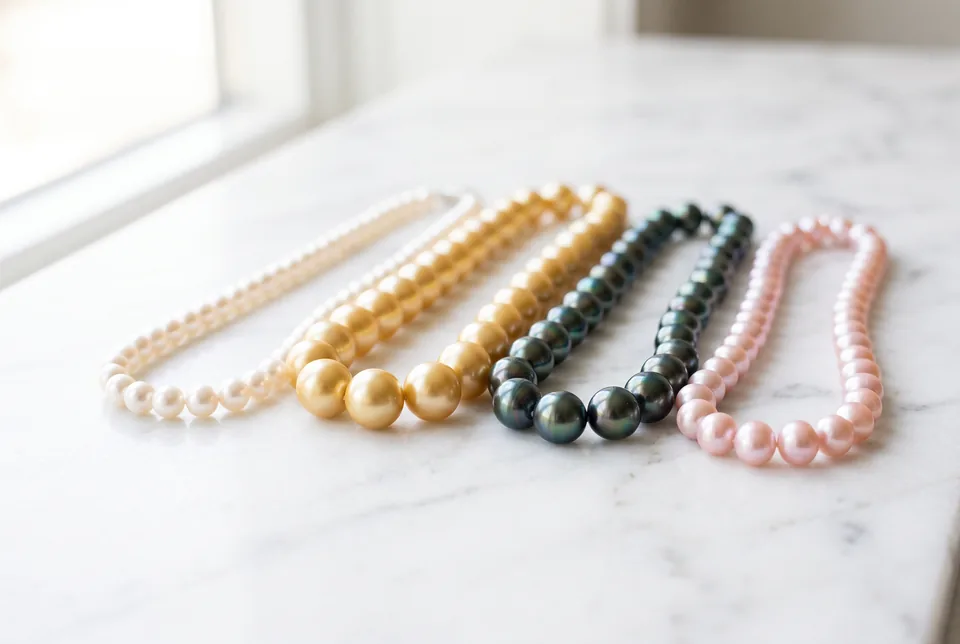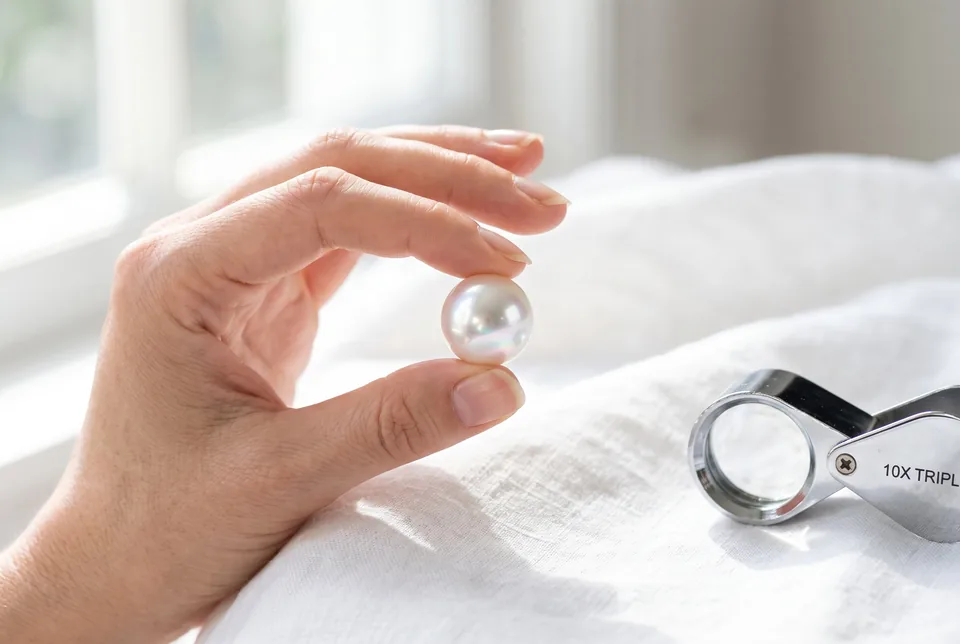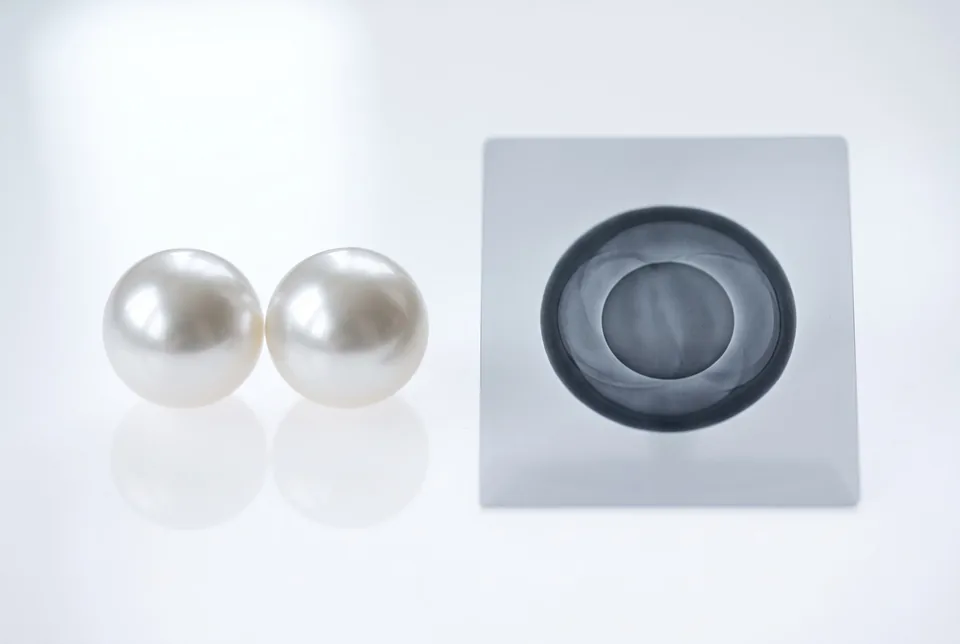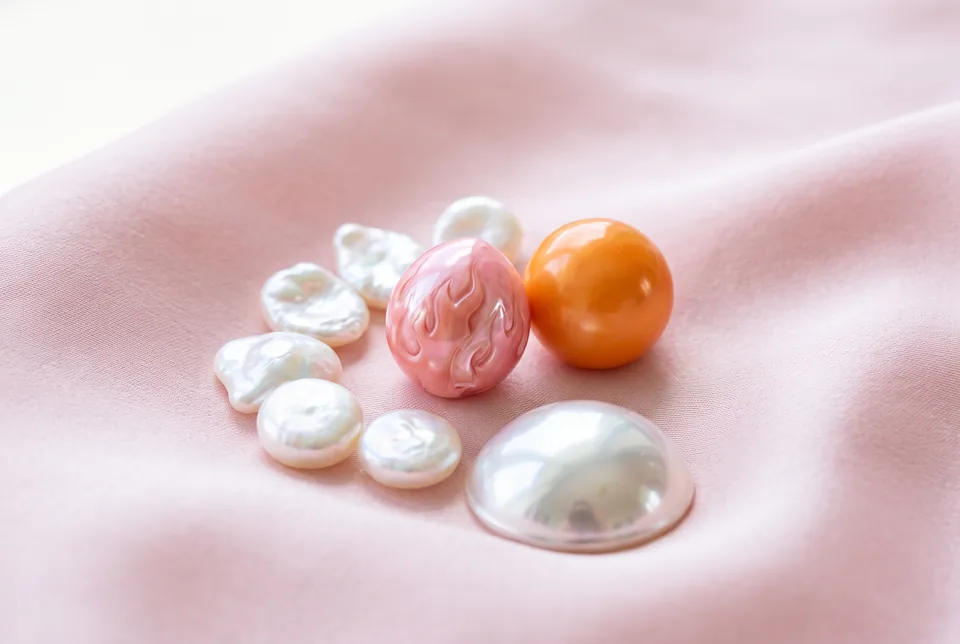
Anyone who meets these four names in the jewellery trade is dealing with two different worlds. Keshi and Mabe are farmed products from the everyday work of pearl farms in the mid-price range. Conch and Melo are chance finds from the sea, counted in pieces per year and traded from several thousand euros per carat.
Two farmed products, two natural pearls
The group looks like a catch-all for everything that is not round and white, yet it divides cleanly. Keshi and Mabe come from pearl farms, from oysters into which a person has inserted tissue or a nucleus; under the rules of the world confederation CIBJO they are cultured pearls. Conch and Melo come from marine snails that form no nacre and rank among the rarest natural pearls.
The second difference is the material. Classic pearls and Keshi consist of nacre, tiny platelets of aragonite, a crystal form of calcium carbonate, stacked in layers. Mabe carry a thin nacre layer over a foreign body. Conch and Melo build their calcium carbonate in crossed bundles; they do not shimmer but display a flame pattern. How cultured pearls are made explains nucleus and mantle tissue in detail.
Keshi, the pearl without a nucleus
Keshi is Japanese and means poppy seed. The name comes from Akoya farming, where these pearls really are tiny, usually around 2 mm. They form when the oyster rejects the inserted nucleus but the transplanted mantle tissue stays in the animal and forms a pearl sac that carries on secreting nacre without a nucleus. The result is nacre from the inside out. CIBJO lists it under definition 5.106 as a non-beaded cultured pearl and a by-product of farming.
In South Sea and Tahitian farms, Keshi turn out larger: Perlenforum gives 9 to 12 mm as the South Sea average, Rapaport reports pieces above 25 mm. Without a nucleus every Keshi is baroque, often flat or folded, and their lustre is among the most intense of any pearl. Since the CIBJO definition of 2009 the term applies only to saltwater oysters; Chinese freshwater pieces of similar construction are called keshi-type. According to Rapaport, a strand of Tahitian Keshi costs around 4,000 US dollars, keshi-type freshwater strands of 10 to 12 mm roughly 1,800 US dollars.
Mabe, the half pearl from the inside of the shell
A Mabe grows on the inner wall of the mollusc's shell. The farmer glues a half-round nucleus of plastic, clay or mother-of-pearl onto the nacreous layer, and the oyster coats it with nacre like a blister. After 6 to 12 months the layer is 0.7 to 1.5 mm thick. The blister is sawn out, the nucleus removed, the cavity filled with resin and sealed with a disc of mother-of-pearl. The result is an assembled piece of three parts, which CIBJO calls an "assembled cultured blister", definition 5.14.
The name comes from the mollusc Pteria penguin, known in Japan as Mabe-gai, which according to German Wikipedia accounts for around 75 per cent of production; Pinctada maxima also yields Mabe. Diameters of 10 to 20 mm are usual, individual pieces reach 25 mm. Mabe come as half-spheres, drops, hearts or ovals, almost always set in studs, pendants and rings, where the flat back stays hidden. They cost less than round cultured pearls of the same size, because farming is quick and one oyster carries several nuclei at once.
| Feature | Keshi | Mabe | Conch | Melo |
|---|---|---|---|---|
| Host animal | Pearl oysters (Akoya, Pinctada maxima, Tahitian) | Pteria penguin, Pinctada maxima | Queen conch Aliger gigas | Marine snail Melo melo |
| Origin | Cultured, without nucleus | Cultured, half nucleus on the shell | Natural, not cultured | Natural, not cultured |
| Structure | 100 per cent nacre | Nacre layer 0.7 to 1.5 mm over resin | Aragonite, crossed-lamellar, no nacre | Aragonite, interwoven, no nacre |
| Appearance | Lustre, often orient | Lustre, domed surface | Flame pattern, porcelain-like | Flame pattern, porcelain-like |
| Colour | White, cream, gold, grey to black | White, silver, rosé | Pink to red, also white, brown | Yellow-orange to orange |
| Size | 2 mm (Akoya) to over 25 mm (South Sea) | 10 to 20 mm, up to 25 mm | Usually a few carats, exceptions up to about 80 carats | Up to nearly 400 carats, around 37 mm |
| Price level | Tahitian strand around 4,000 US dollars, keshi-type freshwater strands around 1,800 US dollars | Mid-range, below round cultured pearls of the same size | 2,000 to 15,000 US dollars per carat | Individual pieces in six figures |
Conch, pink flames from the queen conch
The queen conch, Aliger gigas, formerly Strombus gigas, lives in the Caribbean, off the Bahamas and the Florida Keys. It is fished for its meat; the pearl is a chance find when the animal is cleaned. The Jewellery Editor cites one pearl per 10,000 to 15,000 snails, of which fewer than 10 per cent reach gem quality. The British Gemmological Association puts the range at one pearl per 50,000 to 2,000,000 shells. Either way, a fine conch pearl is a find, not a product.
Its colour ranges from delicate pink to strong pink, brown and white. The most coveted feature is the flame structure, a silky, shifting pattern like flickering flames. Most conch pearls weigh a few carats; the heaviest known piece is around 80 carats. The Jewellery Editor gives 2,000 to 3,000 US dollars per carat for good pearls, 4,000 to 7,000 for top pieces and up to 15,000 for exceptional stones. The auction record is a Cartier bracelet from the late 1920s once owned by Queen Victoria Eugenia of Spain: estimated at 750,000 to 1,300,000 CHF, it sold on 14 November 2012 at Sotheby's in Geneva for 3,274,500 CHF.
Melo, the orange pearl from the Indo-Pacific
Melo melo is a large marine snail from the shallow coastal waters of Vietnam, Myanmar, Thailand and Malaysia, with a shell of up to 30 cm. Its pearl is unique in colour: yellow-orange to vivid orange, with the same flame structure as the conch pearl, only coarser. Melo pearls rank among the largest natural pearls: the Gemmological Association describes a famous piece of around 37 mm and almost 400 carats, and the "Gran Dama" brooch by Gianmaria Buccellati carries a Melo of 98.67 carats, which the GIA counts among the largest in the world.
Melo pearls are not cultured, which keeps the market tight. When Christie's in Hong Kong first offered a Melo of 23 × 19.35 mm, the estimate was 20,000 to 30,000 US dollars, the hammer price 488,311 US dollars. Demand from Asia, above all Vietnam, sustains these prices.
Why Conch and Melo do not shimmer
The lustre of a classic pearl arises from light refracting through thousands of stacked aragonite platelets. Conch and Melo also consist of aragonite, but the snail arranges the crystals in crossed bundles, a crossed-lamellar microarchitecture in CIBJO's words. This produces no shimmer but the flame pattern and a porcelain-like sheen. Calcite plays no part here; in 2024 a dyed calcite sphere in the GIA laboratory was the giveaway for a Melo imitation.
A non-nacreous natural pearl of calcium carbonate, arranged concentrically in a crossed-lamellar microarchitecture. This structural feature typically produces a flame-like surface pattern and a porcelain-like sheen.
CIBJO Pearl Book 2024, definition 5.48 Conch Pearl (paraphrased)
For a long time the trade argued whether such pieces could be called pearls at all; the technical term was "calcareous concretion". The 2024 CIBJO Pearl Book now lists Conch and Melo under definition 5.141 as "non-nacreous natural pearls", and the GIA issues reports for them. The line between natural and cultured remains the most important in the trade: Natural or cultured pearl.
What this means when buying
For Keshi and Mabe the usual rules for cultured pearls apply: lustre, surface and colour decide, and a certificate is not customary at prices in the hundreds. With Mabe, check the nacre layer: thinner than 0.7 mm, it can crack or separate from the resin. Keshi should be declared as saltwater cultured; otherwise they are usually cheaper freshwater goods. For Conch and Melo a report from GIA or SSEF is essential, confirming species, natural origin and untreated colour. A Melo without a report is like a ruby without papers.
A word on cultured conch pearls: CIBJO recognises the definition "cultured conch pearl", because trials at Florida Atlantic University had produced more than 200 pearls by November 2009. In the trade this plays no part so far. Anyone who owns an inherited special pearl should have it appraised; process and costs are set out in Inherited pearls.
Frequently asked questions
Are Keshi pearls natural pearls?
No. Keshi form without a nucleus, but inside a farmed oyster into which a person has inserted tissue. CIBJO lists them as non-beaded cultured pearls (definition 5.106). They consist of 100 per cent nacre but remain cultured goods.
What exactly is a Mabe pearl?
A half pearl that grows on the inside of the shell over a glued-on half nucleus. After 6 to 12 months a nacre layer of 0.7 to 1.5 mm has formed. It is cut out, the nucleus removed, the cavity filled with resin and backed with mother-of-pearl.
Why are conch pearls so expensive?
Because they are not cultured and only about 1 in 10,000 to 15,000 queen conchs carries a pearl, fewer than 10 per cent of those in gem quality. Good pieces cost 2,000 to 7,000 US dollars per carat, exceptional ones up to 15,000. A Cartier bracelet with conch pearls fetched 3,274,500 CHF at Sotheby's in 2012.
Do conch pearls and Melo pearls have nacre?
No. Both consist of aragonite like classic pearls, but the crystals lie in crossed bundles rather than platelets, so they show a flame pattern and a porcelain-like sheen instead of shimmer. CIBJO calls them non-nacreous natural pearls.
What colour is a Melo pearl?
Yellow-orange to vivid orange, rarely white. Melo pearls rank among the largest natural pearls: the Gran Dama brooch carries a Melo of 98.67 carats, the heaviest known piece weighs almost 400 carats at around 37 mm.
Sources
- CIBJO Pearl Book 2024 (definitions 5.14, 5.48, 5.56, 5.106, 5.112, 5.119, 5.141) CIBJO, The World Jewellery Confederation
- Understanding rare non-nacreous pearls Gemmological Association of Great Britain
- Lab Notes: Two Imitation Melo Pearls (Gems & Gemology, Fall 2024) GIA, Gemological Institute of America
- Gran Dama Brooch Featuring Large Melo Pearl (Gems & Gemology) GIA, Gemological Institute of America
- Conch pearls: what are they and why are they so valuable? The Jewellery Editor
- Lot 594: Conch pearl, enamel and diamond bracelet, Cartier, late 1920s (Magnificent Jewels, Geneva, 14 November 2012; result according to The Jewellery Editor) Sotheby's
- Defining Keshi Rapaport Magazine
- Keshi Perlen (Mohnsamen Perlen) entstehen per Zufall (in German) Perlenforum
- Mabé-Perle (in German) Wikipedia (third-party source)
- Melo Pearl, article by David Federman on the Christie's auctions in Hong Kong Pearl-Guide.com
- Creating Cultured Pearls From The Queen Conch: Scientists Unlock Mystery (5 November 2009) ScienceDaily / Florida Atlantic University