Anyone buying a pearl necklace will almost always read three letters: AAA. They look like a seal of approval, yet they are a trade convention that every seller fills with its own figures. Behind them stand four systems with very different degrees of authority, and once you know them, you can spot a good offer at a glance.
Seven factors on which every assessment rests
The Gemological Institute of America, GIA for short, is the gemmological institute whose diamond scale is used worldwide. It does not describe pearls with letters but with seven value factors: size, shape, colour, lustre, surface quality, nacre quality and matching. Lustre means the sharpness of the reflection on the pearl. Matching means how evenly the pearls in a strand agree with one another in size, colour and shine. Each factor is described on its own. There is no overall grade.
For lustre the GIA recognises five levels: Excellent with bright, sharp reflections, Very Good with bright, almost sharp reflections, Good with bright reflections that blur at the edges, Fair with weak reflections and Poor with dull ones. A GIA report is therefore a description, not a ranking, and that is precisely what makes it reliable.
The dealer scale A to AAA and its gap
The letter scale from A to AAA is used in the trade in Japan and Hong Kong and is widespread in the sale of Akoya, South Sea and freshwater pearls. AAA stands for the highest level. More than three As do not exist in the original system. A German pearl forum puts it plainly: there is no uniform, generally recognised grading system for pearl quality. Every dealer draws its own boundaries, and they are visibly far apart.
A comparison of two German sellers shows the extent of it. An established jeweller defines AAA as a round pearl with strong lustre whose surface is 95 percent free of growth marks, with a nacre layer of at least 0.7 mm. An online pearl dealer sets AAA at a minimum of 98 percent blemish-free surface. Both list the intermediate level AA+ at 90 percent, and the jeweller additionally requires 0.5 mm of nacre for it. The jeweller expressly describes its table as an example intended only for orientation. Both definitions are consistent in themselves, but they are not comparable. Whoever buys AAA from one dealer may be buying AA+ from the other.
| Grade | Jeweller | Online dealer |
|---|---|---|
| AAA | 95 % of surface blemish-free, nacre from 0.7 mm, strong lustre | 98 % of surface blemish-free, brilliant lustre |
| AA+ | 90 % of surface blemish-free, nacre from 0.5 mm, radiant lustre | 90 % of surface blemish-free, almost flawless |
| AA | 80 % of surface blemish-free, nacre from 0.35 mm | 85 % of surface blemish-free |
| A | irregular shape, nacre under 0.2 mm, weak lustre | over 25 % of surface with growth marks |
Both dealers warn against offers with four As, and the online dealer also against five. Such grades exist in no system. Anyone who reads them is better off asking for percentages and millimetres. What distinguishes one pearl from another by type in any case is set out in the comparison Akoya, South Sea, Tahitian or freshwater.
Tahiti regulates its classes by law
Tahitian pearls enjoy something rare, namely a state classification. French Polynesia regulates farming and marketing in Country Law No. 2017-16 of 18 July 2017, which replaced the regulations of 1993 to 2005. The authority responsible for pearl farming inspects pearls after harvest and before export and seals the lots. The inspection checks origin and registration, and since 2017 no longer a minimum thickness. Only holders of a professional card who have passed the inspection may export.
The classes are based on the share of the surface that carries flaws. The law names the criteria, and the percentage limits are set out in its implementing decree. Class A allows at most one flaw or one group of slight flaws on no more than 10 percent of the surface, with very fine lustre. Class B allows slight flaws on no more than 30 percent, class C on no more than 60 percent, each with lustre ranging from very good to medium. Class D covers pearls with slight flaws on more than 60 percent or with deep flaws on up to 60 percent of the surface. A plus sign marks exceptional lustre.
One rule has fallen away. Until 2016 Tahitian pearls had to show a nacre layer of at least 0.8 mm across 80 percent of the surface, otherwise they were destroyed. Since January 2017 this minimum thickness no longer exists, and thin-shelled pearls may also pass the inspection. Nacre thickness is now an additional criterion that the authority determines by X-ray on request.
Hanadama, the best-known laboratory seal
Hanadama, Japanese for flower pearl, is the best-known quality designation backed by a laboratory with fixed measured values. In Japan several testing bodies award the title according to their own criteria, so the same necklace can be Hanadama at one laboratory and not at another. The authoritative body is the Pearl Science Laboratory in Tokyo, which also recognises the higher levels Aurora Hanadama and Aurora Tennyo. The laboratory was founded in 1978, had its grading system patented in 2000 and issues the certificate exclusively for Akoya pearls. Each strand receives its own certificate number.
The examination comprises four measurements. Nacre thickness must be at least 0.4 mm per side, in other words 0.8 mm measured across the nucleus, verified by fibre optics and soft X-ray. Lustre is measured as the Teri value, which is the share of light reflected at the surface, and must reach the level very strong. Under magnification, fewer than 5 percent of each pearl's surface may show inclusions, and only a single deep inclusion is permitted in the whole strand. The Aurora test uses transmitted light from below to reveal the play of colour, the so-called orient, usually in pink and green. Pearls under 6 mm are not certified, and most Akoya pearls measure 7 to 8 mm anyway.
What the GIA has said since 2023
On 6 September 2023 the GIA announced that it would note the trade term Hanadama on its Pearl Classification Reports. The requirement is an Akoya cultured pearl that meets all six characteristics at once: round to near-round shape, white body colour with or without overtone, lustre Excellent, surface clean to lightly spotted, matching Excellent to Very Good, and sufficient nacre thickness and quality. No surcharge is applied for this.
These pearls fall into the select quality range that is known in the trade as 'Hanadama'.
Wording of the comment on GIA reports, according to the GIA press release of 6 September 2023
The difference from the Japanese certificate lies in the detail. The GIA gives no millimetre figure for nacre thickness. Dealers report in an international pearl trade forum that thickness within a strand varies between 0.4 and over 1 mm, which is why the GIA works with comparison strands. The Pearl Science Laboratory measures the thickness and prints it on the certificate. The GIA confirms the classification, the Japanese laboratory supplies the measured values.
Four systems compared
| System | Awarded by | Criteria | Authority |
|---|---|---|---|
| 7 value factors | GIA, independent laboratory | Size, shape, colour, lustre, surface, nacre, matching, each factor described separately | Verifiable report, no overall grade |
| A to AAA | Each dealer itself | Share of blemish-free surface, lustre, shape; limits vary by seller between 95 and 98 % for AAA | No standard, comparable only within one dealer |
| A to D (Tahiti) | Authority of French Polynesia | Flaws on no more than 10, 30 or 60 % of the surface, lustre; nacre on request | Country Law 2017-16 with implementing decree, inspection after harvest and before export |
| Hanadama | Pearl Science Laboratory Tokyo, other Japanese testing bodies with their own criteria | Nacre from 0.4 mm per side, inclusions under 5 %, Teri value, Aurora test | Laboratory certificate with number, Akoya only |
| Hanadama comment | GIA since 6 September 2023 | Six characteristics at once, including lustre Excellent, surface clean to lightly spotted | Additional comment on the report, no surcharge |
Comparing prices across dealers only works with numbers. Place two AAA necklaces side by side and you are comparing two definitions. Place two reports with nacre thickness, lustre grade and share of blemish-free surface side by side and you are comparing two pearls. How that translates into euros is set out in the overview What does a pearl necklace cost.
How to read an offer properly
A reputable offer translates its letters into measured values. If they are missing, a good dealer will answer the question in writing. Five details are enough to place any designation.
- Share of blemish-free surface in percent rather than letters alone.
- Nacre thickness in millimetres; for Akoya, 0.4 mm per side is the Hanadama threshold of the Pearl Science Laboratory, for Tahitian pearls 0.8 mm was the minimum until 2016.
- Lustre in one of the five GIA levels from Excellent to Poor.
- Shape and matching within the strand, meaning whether all pearls agree in size and shade.
- For certificates, the number, the laboratory and the date; a Hanadama certificate without a strand number is no certificate.
With inherited necklaces these details are almost always missing. An independent appraisal is then worthwhile, one that describes the strand according to the seven factors and measures the nacre thickness. What it costs and how it works is explained in the article Having inherited pearls appraised.
Lustre comparison
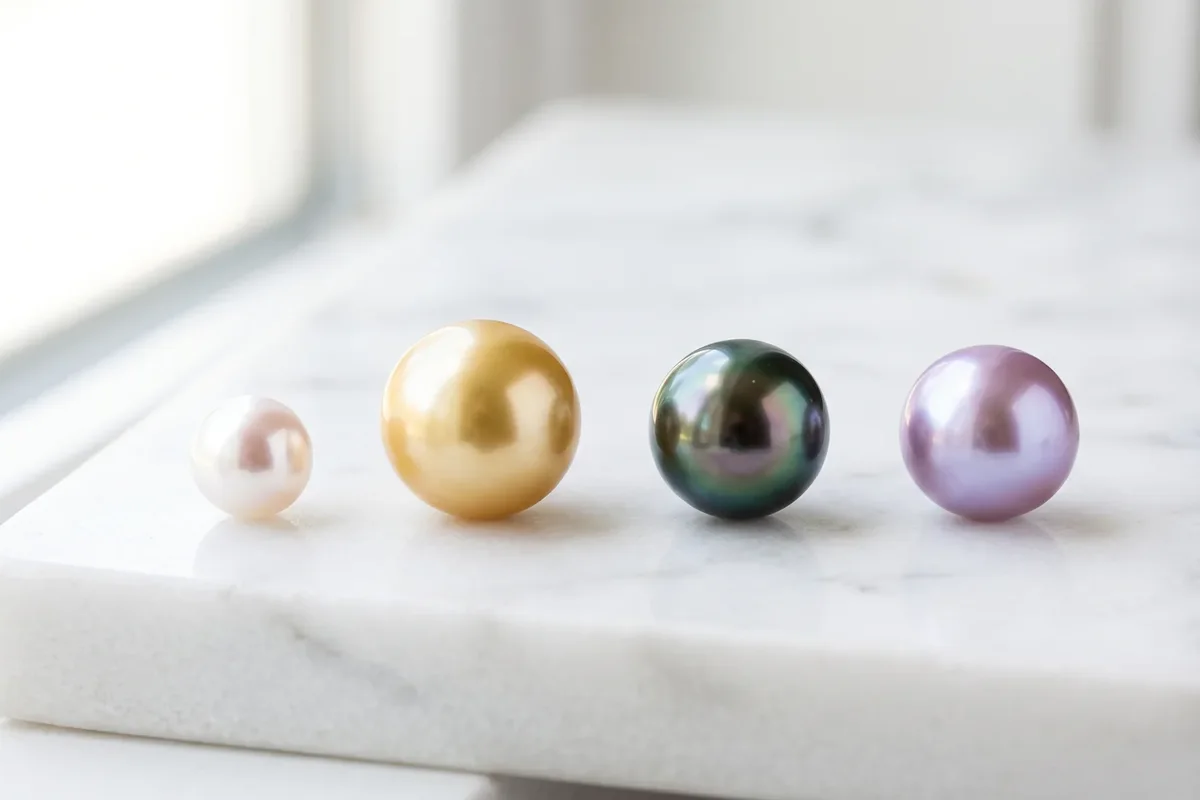
Matte on the left, mirror bright on the right: drag the glass edge. Same strand, only the lustre changes.
 mattemirror
Frequently asked questions
Is AAA an official quality grade for pearls?
No. A to AAA is a trade convention from Japan and Hong Kong for which no standard exists. German dealers set AAA at between 95 and 98 percent blemish-free surface, so the limits differ even within one country. The grade is comparable only within a single seller.
What does Hanadama mean for Akoya pearls?
Hanadama is a Japanese laboratory designation for Akoya pearls of the very highest quality. At the Pearl Science Laboratory in Tokyo it requires at least 0.4 mm of nacre per side, under 5 percent inclusions per pearl, at most one deep inclusion in the strand and the lustre rating very strong. Each strand receives its own certificate number. Other Japanese testing bodies award the title according to their own criteria.
Are there AAAA pearls?
Not in any of the known systems. The original system ends at three As, and specialist German dealers expressly warn against offers with more than three As. Such labels are meant to suggest a quality that cannot be substantiated.
Which value factors does the GIA use for pearls?
The GIA describes pearls according to seven factors: size, shape, colour, lustre, surface quality, nacre quality and matching. For lustre there are five levels from Excellent to Poor. The GIA does not award an overall grade.
How are Tahitian pearls classified?
French Polynesia regulates the classes A to D on the basis of Country Law 2017-16 of 18 July 2017 and its implementing decree. Class A allows flaws on no more than 10 percent of the surface, B on 30 percent, C on 60 percent, and D lies above that or has deep flaws. The former requirement of 0.8 mm of nacre has not applied since January 2017.
Since when has Hanadama appeared on GIA reports?
Since 6 September 2023. The GIA notes the term when an Akoya cultured pearl meets six characteristics at once, including lustre Excellent and a surface from clean to lightly spotted. The comment carries no surcharge.
Sources
- Pearl Quality Factors Gemological Institute of America (GIA)
- GIA Adds 'Hanadama' Quality Range Comment to All Pearl Classification Reports GIA, press release of 6 September 2023
- Understanding the Hanadama Pearl Certificates Pure Pearls
- What are Hanadama pearls? Evaluation criteria and definitions Ginza Repearl
- GIA adds Hanadama Quality Indicator to Certificates Pearl-Guide.com
- Legislation concerning pearls in French Polynesia Taaroa Bijoux
- How to classify Tahitian Pearls Taaroa Bijoux
- Tahitian minimum nacre depth law scrapped Pearlescence
- Den Wert einer echten Perle ermitteln (in German) Brogle
- A-AAA System (in German) Edelkontor
- Perlen Bewertungssysteme (in German) Perlenforum