The silk between the pearls is the only part of a necklace that is designed to wear out. It stretches, absorbs perspiration and perfume, and eventually turns grey. Anyone who knows the warning signs and understands the pricing will spend less on a restring than on a dinner out, and will spare their pearls the one moment when the thread gives way.
What restringing costs
The bill has two parts. The base charge covers taking the old necklace apart, the new silk and attaching it to the clasp. On top comes an amount per knot, because every pearl is knotted individually. Juwelier Krebs in Herborn quotes a flat 10 euros plus 0.25 euros per knotted pearl, or 0.20 euros per pearl for plain stringing without knots. Casa Perla charges a base of 16 euros plus 0.30 euros per knot and works out a 50-pearl necklace at 31 euros. Perlenreich Atelier uses tiered pricing: up to 40 pearls 8.90 euros, up to 80 pearls 11.90 euros, up to 140 pearls 20.90 euros, each plus postage. The retailer perlen-und-ketten.de quotes 3 to 8 euros for stringing and 0.35 euros per knot.
A new clasp, a clean for the pearls or replacing damaged bead caps (the small metal cups that hide the thread at the clasp) are charged on top. If you are taking an inherited necklace to a workshop for the first time, it makes sense to have it assessed at the same time. How that works and what it costs is explained in Inherited pearls: how to have them appraised.
| Workshop | Base charge | Per knot | 60 pearls in total |
|---|---|---|---|
| Juwelier Krebs, knotted | 10 euros | 0.25 euros | 25 euros |
| Juwelier Krebs, strung only | 10 euros | 0.20 euros | 22 euros |
| Casa Perla | 16 euros | 0.30 euros | 34 euros |
| Perlenreich Atelier | tier up to 80 pearls | included | 11.90 euros plus postage |
| Guide range | 3 to 16 euros | 0.20 to 0.35 euros | 15 to 34 euros |
Worked example for a classic 45 cm necklace
The number of pearls sets the price, not the length in centimetres. A 45 cm necklace, the so-called princess length, holds around 59 pearls at 6.5 to 7 mm, or in theory up to 64 without knots. The count comes from a pearl specialist forum: 59 pearls of 6.5 to 7.0 mm make 46.5 cm without the clasp. Taking 60 pearls as the working figure, Krebs comes to 10 plus 60 times 0.25 euros, so 25 euros. At Casa Perla it is 16 plus 18 euros, so 34 euros. The guide range of 15 to 34 euros is so wide because some workshops keep the base charge low (perlen-und-ketten.de quotes 3 to 8 euros for stringing plus 0.35 euros per knot) and price the knots higher, while others do the reverse.
Small pearls mean more work than large ones. A choker of 5 mm Akoya pearls runs to more than 80 knots, a South Sea necklace of 12 mm pearls to just under 40. So the price for the smaller, cheaper pearl can end up higher. The drill hole matters to the workshop as well: Akoya pearls often have very fine holes, while large South Sea and Tahitian pearls need heavier silk because of their weight.
Warning signs that the silk is finished
Silk stretches under the weight of the pearls and with moisture. It loses its tension before it breaks. The signs are easy to see if you hold the necklace up to the light.
- Gaps: thread becomes visible between pearl and knot, and the pearls slide back and forth on the thread.
- Dark knots: the silk was white or cream and has turned grey or brownish. It has absorbed perspiration, skin oils and creams.
- Fraying: the knots look woolly, and fibres stick out at the clasp.
- Stiff drape: the necklace no longer falls softly around the neck but holds curves.
- Vanishing knots: the knots are being pulled into the drill holes and are barely visible.
Any one of these signs alone justifies a trip to the workshop. Waiting until the thread breaks risks one pearl on a knotted necklace. On a necklace that is merely strung, all of them roll away.
How often to restring
The trade's recommendations sit close together. Juwelier Risch and the American retailer The Pearl Source both say every one to two years with regular wear. Juwelier Roller recommends having the necklace checked roughly every two years, sooner if worn often. The German silk maker Griffin, founded in Schramberg in 1866, gives two to five years for daily wear, provided the necklace is wiped after each wearing. The British Pearl Association goes furthest and advises restringing every year.
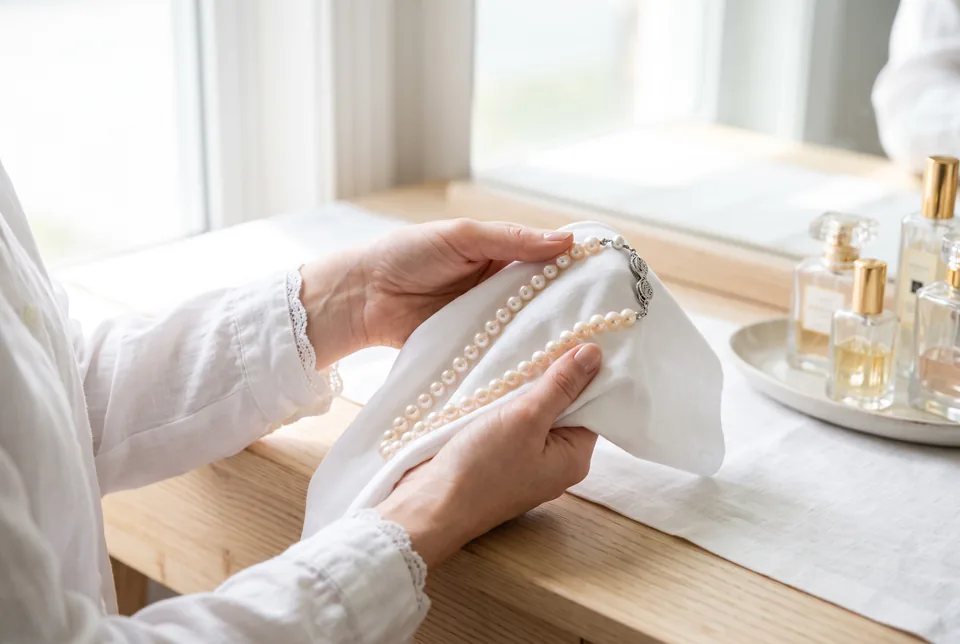
The difference comes down to skin. A necklace worn directly on the skin ages faster than one worn over a jumper. According to GIA, nacre has a Mohs hardness of 2.5 and is attacked by hairspray, perfume, cosmetics and perspiration. The same substances take their toll on the silk. Wiping the strand with a soft cloth after wearing extends the life of both pearl and thread. What else nacre will and will not tolerate is covered in Pearl care and storage.
| Wearing habit | Interval | Source |
|---|---|---|
| Daily, directly on the skin | 1 to 2 years, sooner in some cases | Juwelier Risch, The Pearl Source |
| Regularly, wiped after wearing | 2 to 5 years | Griffin |
| Occasionally, for special occasions | well beyond 1 to 2 years, check annually | The Pearl Source, British Pearl Association (restring annually) |
| Heirloom, years in the jewellery box | check for loose thread and play between the pearls before wearing for the first time | Editorial recommendation |
Knotting or plain stringing
With plain stringing, the pearls sit directly against each other on the thread. With knotting, a knot tied in the silk itself sits between every two pearls. At Krebs that costs 0.05 euros more per pearl and brings three benefits, which the British Pearl Association describes as follows: the pearls do not rub against each other, which protects the soft nacre; if the thread breaks, at most one pearl is lost; and the necklace drapes more softly and moves more freely. For cultured pearls from about 5 mm upwards, knotting is the standard. Only very small seed pearls or necklaces with metal spacers are strung without knots.
A necklace whose silk has stretched over the years can be noticeably shorter after restringing. Juwelier Krebs points out that the thread lengthens over time, so freshly restrung necklaces come out shorter. Conversely, the knots themselves make a necklace longer: in the Butschal jewellery forum, a difference of 5 to 6 cm between knotted and plain strung is calculated for 73 pearls. Anyone who needs the old length has a pearl added or chooses a clasp with an extender.
Why silk rather than nylon
Pearl silk is twisted natural silk in standardised gauges. Griffin lists No. 4 at 0.60 mm for small freshwater pearls, No. 6 at 0.70 mm for Akoya pearls and No. 8 at 0.80 mm for larger pearls. As a rule of thumb, the thread number roughly matches the pearl diameter in millimetres, so No. 6 for 6 mm. A 45 cm necklace needs 1.5 to 2 m of silk, because every knot uses up thread and the ends need purchase at the clasp.
Silk is soft, pulls into small, firm knots and gives the necklace its fluid drape. That very softness is also its weakness: it absorbs moisture and stretches. Nylon stretches less and absorbs hardly any moisture, but it is harder, the knots stay bulkier and the necklace lies more stiffly. Nylon-coated steel wire, which Juwelier Risch mentions for heavy strands, withstands a great deal of pull but cannot be knotted and is secured with crimp beads. For a classic necklace of Akoya, freshwater or South Sea pearls, silk remains the workshops' choice because it is kind to the pearl. That it ages is the price, and that price is 25 to 40 euros every few years.
Procedure and waiting time
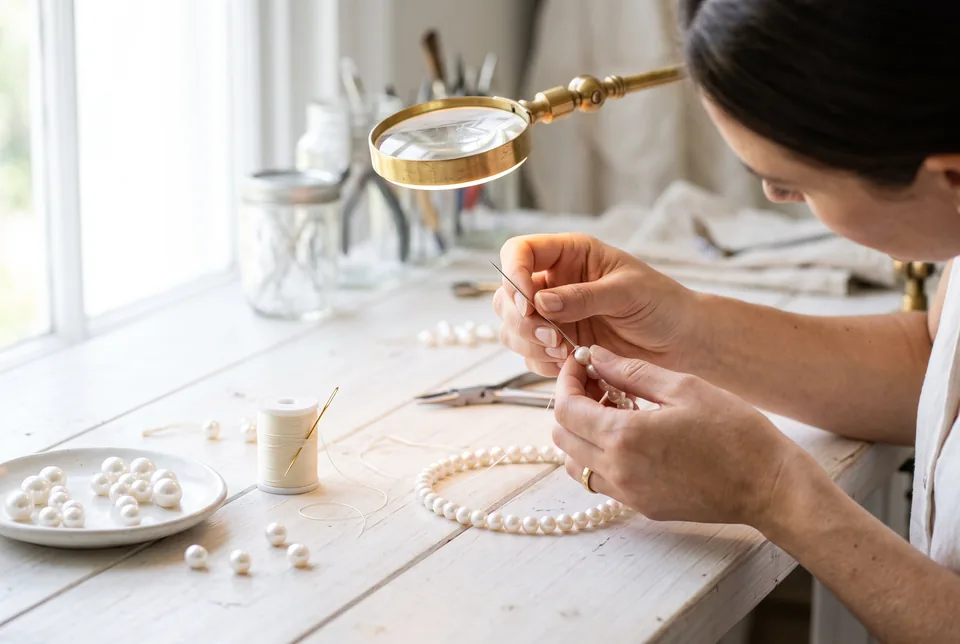
The workshop cuts the old silk, cleans the drill holes, lays the pearls out in their original order on a bead board and knots them onto new silk. Pure working time: for a necklace of 40 pearls, a knotting guide by Schmuckmueller gives around 30 minutes excluding preparation, so around 45 minutes for 60 pearls. Even so, Juwelier Risch allows one to two weeks, because in many businesses pearl work is done by one specialist on set days. If you need the necklace for a particular date, take it in three weeks beforehand. And if you compare the colour of the knots at collection with their state before the repair, you will see at a glance why the restring was overdue. How pearls age in general and why some turn yellow is explained in How long do pearls last.
Frequently asked questions
How much does it cost to have a pearl necklace restrung?
A jeweller charges a base of 3 to 16 euros plus 0.20 to 0.35 euros per knot. A 45 cm necklace with around 60 pearls therefore comes to 25 to 34 euros. A new clasp is extra.
How often does a pearl necklace need restringing?
Every one to two years with regular wear, every two to five years with occasional wear. Wiping the necklace after wearing and wearing it over clothing gets you to the longer end of the range.
How do I know my pearl necklace needs restringing?
By visible thread between pearl and knot, by knots that have turned grey or brown, by fraying at the clasp and by a necklace that drapes stiffly. Any one of these signs is reason enough for a trip to the workshop.
Why are pearls knotted rather than simply strung?
The knot between the pearls stops them rubbing against each other, since nacre has a Mohs hardness of only 2.5. If the thread breaks, at most one pearl is lost instead of all of them. The surcharge is around 0.05 euros per pearl.
How long does restringing take at the jeweller?
The knotting itself takes a practised hand about 30 minutes per 40 pearls, but the workshop allows one to two weeks of turnaround. Before a fixed date, hand the necklace in three weeks ahead.
Will the necklace be shorter after restringing?
Yes, if the old silk had stretched, because the thread lengthens over the years. Having a knotted necklace restrung without knots loses further length: for 73 pearls, the specialist forum quotes 5 to 6 cm. Length can be added with an extra pearl or via the clasp.
Sources
- Perlen: Aufziehen und Knoten in der Werkstatt Juwelier Krebs, Herborn
- Reparatur Casa Perla
- Perlenkette neu knoten Perlenreich Atelier
- Perlenschmuck: Service und Reparatur perlen-und-ketten.de
- Perlenkette neu aufziehen lassen: Kosten, Techniken und Meister-Tipps Juwelier Risch
- Perlenketten aufziehen Juwelier Roller
- Pearl Knotting Necklace: Start and Finish Guide Griffin 1866
- Pearl Care and Cleaning Gemological Institute of America (GIA)
- How to String Pearls British Pearl Association
- Pearl Care and Maintenance Guide The Pearl Source
- Number of pearls per inch Pearl-Guide.com
- Perlenkette neu aufziehen lassen: Kosten? Schmuckforum Butschal
- Perlenkette knüpfen Schmuckmueller