Pearls are roughly 80 to 92 per cent calcium carbonate, held together by a wafer-thin organic binder. The mineral barely ages, the binder does. Anyone who understands where discolouration begins, and how much nacre thickness forgives it, can judge an inherited strand properly and buy a new one with decades in mind.
What museums and auctions prove
The best known answer to the question of durability hangs on a single pearl. La Peregrina, the wanderer, was found off the Pearl Islands of Panama in 1513 and passed to King Philip II of Spain. In 1913 it was redrilled and cleaned. When Christie's sold the pearl from the estate of Elizabeth Taylor in December 2011, it weighed 50.56 carats. The price, including premium, came to 11,842,500 US dollars, more than four times the estimate of 2 to 3 million. Almost 500 years after it was found, the pearl was neither dull nor cracked, but the most expensive pearl necklace ever sold at auction up to that point. The record for a single pearl has been held since 2018 by a pendant from the collection of Marie Antoinette, sold for around 36 million US dollars at Sotheby's in Geneva.
The find from Marawah Island off Abu Dhabi reaches back even further: a natural pearl from layers dated to 5800 to 5600 BC, nearly 8,000 years old, now in the Zayed National Museum. Under favourable conditions, then, nacre survives practically indefinitely. All three examples, however, are natural pearls without a bead nucleus. The same chemistry applies to cultured pearls, but the geometry is different, and geometry decides how they age. More on the records under The most expensive pearls in the world.
What a pearl is made of
Nacre is a composite material. Tiny platelets of aragonite, a crystalline form of calcium carbonate, lie in rows on top of one another like bricks. Between them sits conchiolin, a protein that acts as mortar and gives the whole its toughness. According to the Gemological Institute of America, or GIA, pearl reaches a Mohs hardness of only 2.5. Ageing, drying out and excessive bleaching make the material more brittle still, and because calcium carbonate reacts with any acid, sweat, perfume, hairspray and cosmetics all attack the surface.
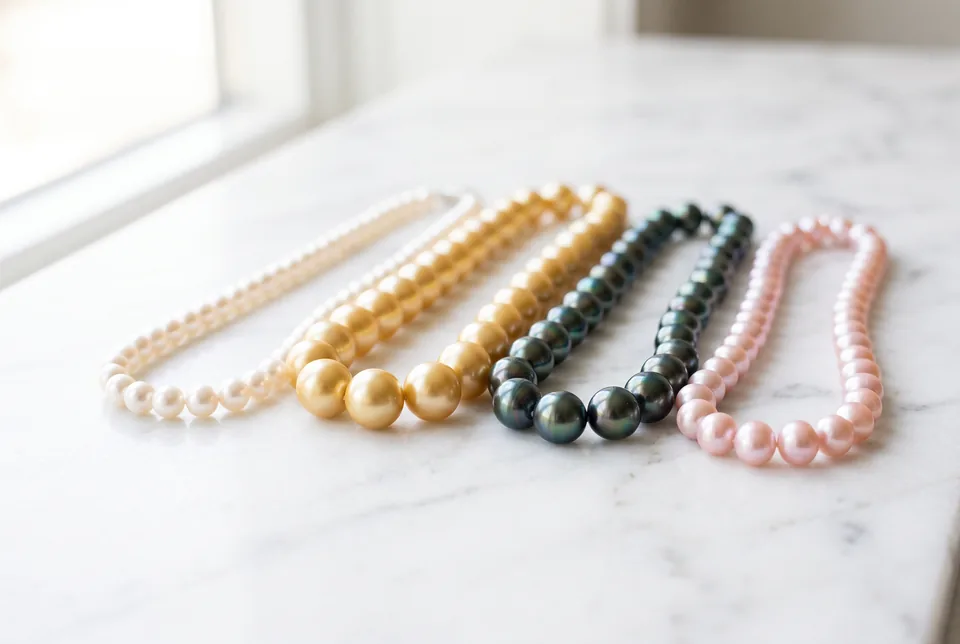
How much nacre a cultured pearl carries depends on its type. Traditional Akoya pearls sold commercially typically have 0.15 to 0.50 mm of nacre around a bead of shell, according to the GIA. Until the end of 2016, Tahitian pearls had to show at least 0.8 mm across 80 per cent of the surface to be exported from French Polynesia; since January 2017 that check no longer applies. South Sea pearls reach 2 to 4 mm, according to Perlenforum. A hybrid Akoya culture from Vietnam examined by the GIA in 2025 showed 1.62 to 1.68 mm of nacre on 6 mm pearls; only around 0.5 per cent of production achieves such figures.
Why pearls turn yellow
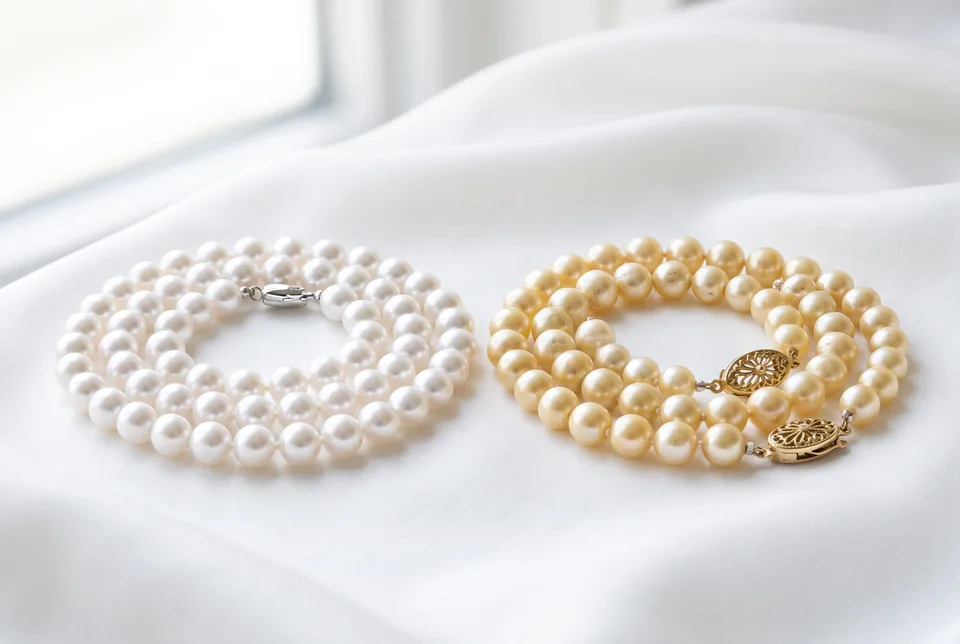
The discolouration sits not in the crystal but in the binder. Conchiolin is organic, contains bound water and ages like ivory or old paper. When the pearl loses moisture, the protein shrinks, micro-cracks form, and the refraction of light between the platelets shifts towards warm tones. Oxidation amplifies the effect: oxygen, smoke and above all UV light break the protein down and produce yellow pigments. The GIA explicitly names intense light as a cause of drying and cracking, while classing pearls as largely stable under normal light.
The second route runs through the skin. Sweat is mildly acidic, perfume contains solvents, sun cream and hairspray leave films behind. All of these either etch calcium carbonate or settle over it as a layer. What then looks yellow is often a coating, not aged nacre, and that difference decides whether the pearl can be saved. Perlenforum even writes that, in its experience, real pearls do not turn yellow; on inherited Akoya necklaces with destroyed nacre, however, it has seen a yellowish bead showing through. Both statements fit together: thick, intact nacre barely discolours over decades, thin nacre reveals the bead.
The question of heat
It is often said that heat slowly converts the aragonite in a pearl into calcite, the more stable form of calcium carbonate, and that this makes the pearl dull. The measurements say otherwise. In the nacre layer of a marine snail, the conversion only begins at 373 ± 15 °C and is complete at 390 ± 17 °C. No jewellery box and no radiator reaches that range. What does happen between 200 and 500 °C is the breakdown of the organic content: the shell material lost around 2 per cent of its weight, pure mineral aragonite almost nothing. The protein fails long before the crystal.
High heat can burn cultured pearls, or cause discoloration, splitting or cracking.
GIA, Pearl Care and Cleaning Guide
In practice, this means heat does its damage through drying, not through crystal chemistry. A windowsill above a radiator, a car in high summer or a hairdryer used to dry a strand all draw water out of the conchiolin. The damage accumulates and cannot be reversed.
Thick and thin nacre
Why cultured pearls age differently comes down to growing time. According to Perlenforum, the mantle tissue of the mollusc deposits 2 to 3 layers of 0.5 to 1.0 micrometres per day. A Tahitian pearl usually grows for 16 to 24 months; in the GIA study, a 4 mm hybrid Akoya took 5 months and a 6 mm pearl around a year. Harvest earlier and you get less layer. The GIA puts it plainly: if the bead is visible beneath the nacre or the pearl looks dull and chalky, the nacre is thin, and very thin nacre compromises durability and lustre.
Thin nacre has three weak points. First, the bead shows through, so the pearl appears to blink or look blotchy against the light. Second, the layer wears away at the drill holes where pearl rubs against knot, exposing the bead. Third, every bit of ageing hits a smaller volume: when a 0.2 mm layer loses moisture, that is the whole pearl; beneath 3 mm of South Sea nacre there is a reserve.
| Symptom | Likely cause | Remedy |
|---|---|---|
| Even yellow or cream tone, lustre intact | Coating of cosmetics, skin oils, smoke | Lukewarm water with mild soap, soft cloth, allow to dry completely |
| Yellow and dull, reflections blurred | Dried out conchiolin, oxidation from light or heat | Not reversible; consider professional cleaning, store at normal humidity rather than in an airtight case |
| Matt, chalky patches | Acid damage from sweat, perfume, chlorinated water | Not reversible; put the strand on after dressing, wipe after wearing |
| Bead shows through, pearl blinks against the light | Very thin nacre (bead visible, per GIA) or layer worn away | Not repairable; replace the pearl or restring the necklace |
| Layer flaking at the drill hole | Friction against knot and neighbouring pearl, brittle nacre | Restring, move the damaged pearl to the clasp end |
| Fine cracks in the surface | Heat, hairdryer, sun, rapid temperature changes | Not repairable; remove the cause so the remaining pearls survive |
What can be saved and what cannot
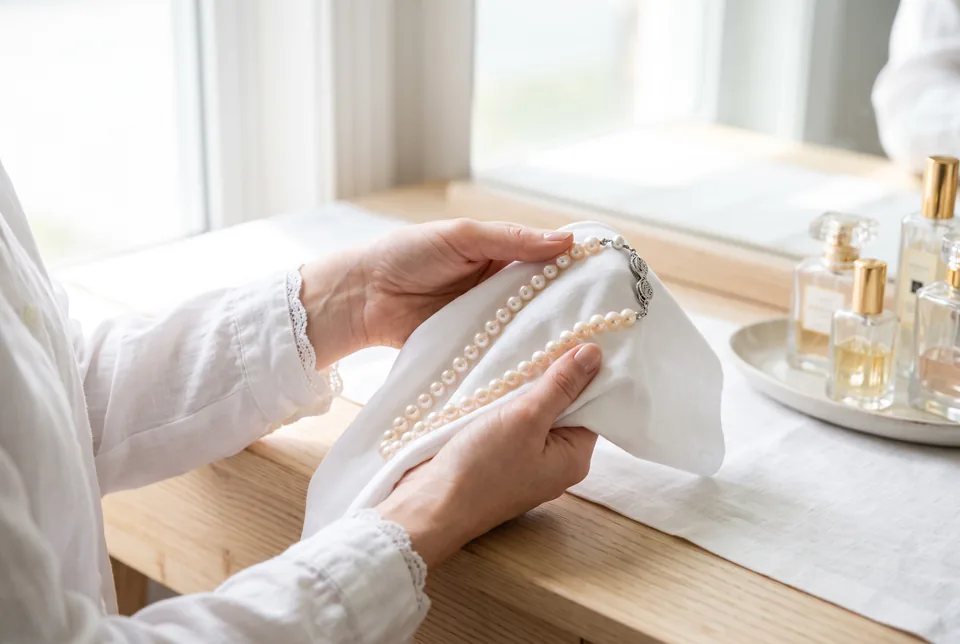
The rule is simple: what sits on the pearl comes off. What sits in the pearl stays. The GIA considers occasional, thorough cleaning with warm soapy water safe, but rules out ultrasonic and steam cleaners. After each wearing, a very soft cloth is enough, and a strung necklace should only go back around the neck once the silk thread has dried completely. A German dealer describes the difference the same way: surface residue can sometimes be removed carefully, but if the change lies deeper in the nacre, the original colour often does not return. An even cream tone across 40 pearls is far less troubling than a single blotchy one.
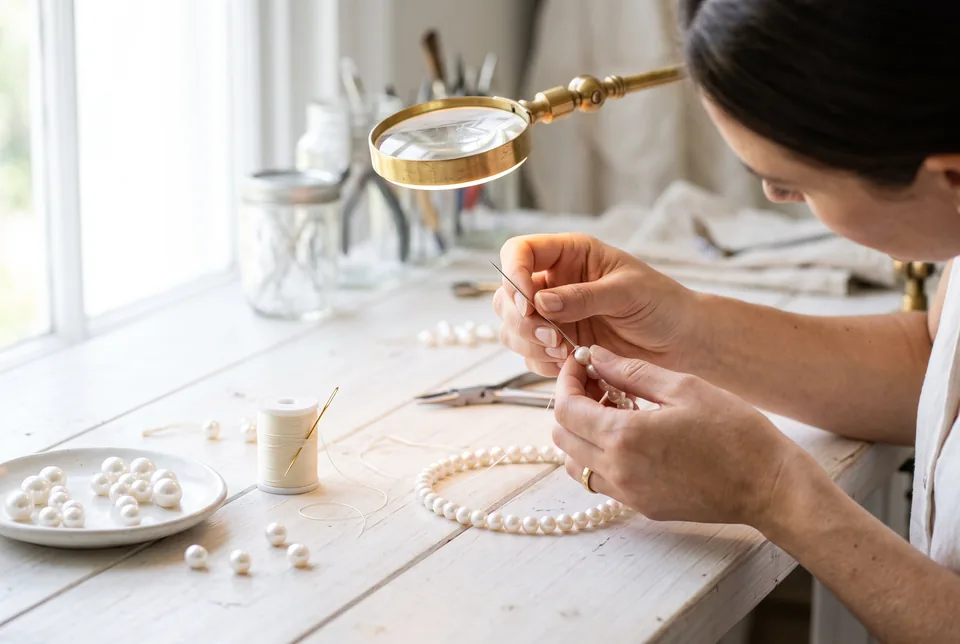
The thread ages faster than the pearl. Perlenforum recommends having necklaces restrung every one to two years. Restringing also exposes the drill holes, where thin nacre gives way first. Process and prices are covered under Having a pearl necklace restrung.
How long a pearl really lasts
The answer has two parts. The mineral, as Marawah and La Peregrina show, lasts centuries to millennia. The question is how long the conchiolin between the layers stays supple, and that depends on layer thickness, light, acid and humidity. A natural pearl or a cultured pearl with 2 to 4 mm of nacre can outlast several generations with careful handling. An Akoya with a 0.15 to 0.25 mm layer stays beautiful as long as it is treated gently, and shows neglect within a few years. Know the thickness at the drill hole and you know the life expectancy. How to protect nacre day to day is described in Pearl care and storage.
Lustre slider
Lustre is the sharpness of the reflection. The slider shows what graders distinguish between poor and excellent.
Frequently asked questions
Do real pearls turn yellow over time?
Yes, but slowly and mainly when the nacre is thin. The discolouration arises in the protein conchiolin between the aragonite platelets as it dries out or oxidises under UV light. Natural pearls such as La Peregrina from 1513 are still intact after almost 500 years, proof that thick nacre survives for centuries.
Can yellowed pearls be made white again?
Only if the tone comes from a coating. Cosmetics, skin oils and smoke can be removed with lukewarm soapy water and a soft cloth; ultrasonic and steam cleaning are ruled out by the GIA. If the discolouration sits within the nacre itself, the original colour does not come back.
How thick should the nacre of a cultured pearl be?
Commercial Akoya pearls range from 0.15 to 0.50 mm, Tahitian pearls had an export minimum of 0.8 mm until 2016, and South Sea pearls reach 2 to 4 mm. If the bead shows through or the pearl looks chalky, the layer is too thin according to the GIA and ages faster.
Does heat damage pearls?
Yes, but not through crystal conversion. Aragonite only becomes calcite at 373 to 390 °C. In everyday life, heat dries out the binder, leaving the nacre brittle and cracked. Radiators, cars in summer and hairdryers should therefore be avoided.
Is it better to wear pearls or leave them in the safe?
Worn pearls stay in the climate they were made for, and damage is noticed early. Airtight bags and dry air near a radiator, by contrast, encourage drying out. Wipe after every wearing and have the necklace restrung every one to two years.
Sources
- Pearl Care and Cleaning Guide Gemological Institute of America
- Pearl Quality Factors Gemological Institute of America
- Exceptional Nacre Thickness of Hybrid Akoya Bead Cultured Pearls (Gems & Gemology, Summer 2025) Gemological Institute of America
- Microstructures in relation to temperature-induced aragonite-to-calcite transformation in the marine gastropod Phorcus turbinatus PLOS One
- Most expensive pearl necklace sold at auction Guinness World Records
- The $137 Million Elizabeth Taylor Jewels Rapaport
- Marie Antoinette's Pearls Break Auction Records in Geneva Sotheby's
- Abu Dhabi Pearl: The World's Oldest Known Natural Pearl Discovered on Marawah Island Department of Culture and Tourism Abu Dhabi
- Perle Wikipedia
- Lüsterglanz: Kriterien zur Qualität von Zuchtperlen Perlenforum
- Perlen Pflege: Tipps zu Reinigung und Aufbewahrung Perlenforum
- Tahitian minimum nacre depth law scrapped Pearlescence
- Werden echte Perlen gelb? Ursachen, Pflege und richtige Aufbewahrung Vallée
- La Peregrina pearl Wikipedia