A pearl is not a stone but a grown composite of lime and protein. That is precisely what gives it its glow, and precisely what makes it delicate: the surface is soft, it reacts to acids and it needs a little moisture from the air. Anyone who understands the chemistry behind it needs no long list of prohibitions, just a few firm habits.
The one rule is last on, first off
Everything that goes onto the skin in the morning goes on before the pearls. Cream, make-up, perfume, hairspray, sun cream: let them absorb and dry, then put the necklace on. In the evening the order is reversed. The pearls come off first, before removing make-up, before the shower, before sport. This single habit replaces half of any care guide.
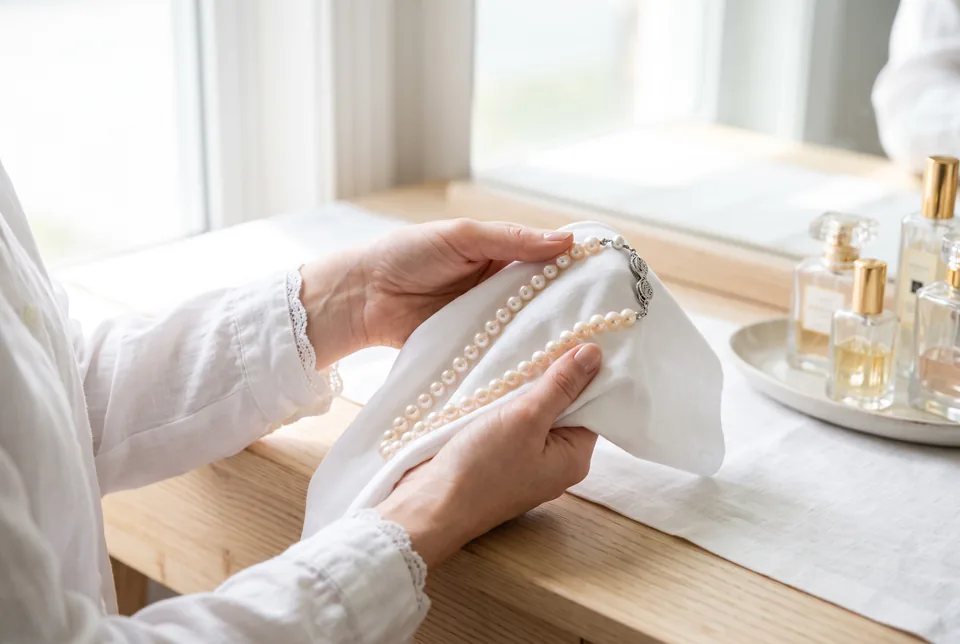
The Gemological Institute of America, or GIA, the gemmological institute whose gradings serve as the benchmark in the trade, sums up the reason in one sentence: pearls can be damaged by many chemicals and by all acids, including hairspray, perfume, cosmetics and even perspiration. After taking them off, a soft cloth is enough, dry or lightly dampened with clean water.
What a pearl is, chemically
Nacre, the material that makes up both the pearl and the inside of the shell, is a composite of two substances. The largest share is aragonite, a crystalline form of calcium carbonate, in other words lime. It occurs as tiny hexagonal platelets, roughly 5 to 20 micrometres wide and less than 1 micrometre thick, stacked like bricks in a wall. Between them sits conchiolin, a structural protein made of chitin and glycoproteins that glues the platelets together. The lime accounts for at least 95 percent, the organic share for 3 to 4 percent, and the rest is water.
Every care rule follows from this structure. The lime dissolves in acid. The protein dries out and turns brittle. And the layers are soft: on the Mohs scale, which measures scratch hardness from 1 (talc) to 10 (diamond), nacre sits between 2.5 and 4.5. A fingernail is about 2.5, and every diamond ring, every metal clasp and every speck of dust is harder than the pearl. If you want to know why nacre turns yellow over the years, the causes are explained in How long do pearls last and why do they turn yellow?
Why acid attacks the surface
Calcium carbonate reacts with any acid to form a calcium salt, water and carbon dioxide. The gemmologist Elisabeth Strack describes in a trade article how a pearl placed in hydrochloric acid vanishes before the observer's eyes within minutes. Everyday life is gentler, but the principle holds. Household vinegar, lemon juice, acidic cleaning products and many cosmetics attack the outermost layer of platelets, and it is exactly this layer that produces the lustre, that soft glow from within. Etched pearls look dull and chalky, and the damage cannot be polished away.
The body supplies acid too. Human sweat has a pH of 4.5 to 7.0 and contains about 0.9 grams of sodium per litre, plus lactic acid and urea. A necklace that has spent a summer's day against the skin has bathed in salt and mild acid. Wiping it in the evening interrupts that reaction before it becomes visible.
Pearls should never be cleaned in an ultrasonic or steam cleaner.
GIA, Pearl Care and Cleaning Guide
Influences compared
| Influence | Effect on the pearl | Recommendation |
|---|---|---|
| Perfume, hairspray, cream | Solvents and acids etch the aragonite layer, lustre goes dull | Put pearls on last, let sprays absorb first; dealers advise up to 30 minutes |
| Sweat (pH 4.5 to 7) | Salt and mild acid attack slowly, the silk soaks it up | Wipe after every wear, let the necklace dry first |
| Ultrasonic, steam | Vibration and heat split the layers, causing cracks and flaking | Never use, not even at the jeweller's for the setting |
| Sun, radiator, car | Protein dries out, pearl turns brittle, colour can fade | Store cool and shaded, 15 to 25 degrees Celsius |
| Safe, airtight box | Air that is too dry draws out water, nacre cracks | Fabric pouch instead of plastic, 45 to 55 percent humidity |
| Hard jewellery in the same compartment | Diamonds and metal edges scratch at Mohs 2.5 to 4.5 | Own compartment or own pouch, lying flat |
Why pearls need air and moisture
Water is not a foreign body in nacre but part of its framework. Materials scientists regard it as the plasticiser of the organic matrix: when nacre dries out, it loses a large part of its toughness and behaves like a brittle material. A bank deposit box with dry air conditioning, a safe in the boiler room or an airtight plastic bag are, over the years, worse than a drawer in the bedroom. A major pearl dealer describes the same process from experience: in a pouch sealed for a long time, the pearl's residual moisture escapes and does not come back.
There is no official storage standard for pearls themselves. Museums, however, have cared for related organic materials such as ivory, horn and tortoiseshell for decades according to fixed values. The Western Australian Museum specifies 15 to 25 degrees Celsius and 45 to 55 percent relative humidity, with fluctuations of no more than 5 percentage points within 24 hours. Pearl dealers usually quote a slightly wider range of 40 to 60 percent. Living rooms usually fall within that range; only in winter, with the heating running, does the air drop below it. Then the goldsmiths' advice helps: place a slightly damp, not wet, linen cloth in the drawer.
Cleaning without causing harm
Daily care is the soft cloth, dry or lightly dampened with clean water. About once a year, or when the pearls are visibly coated, a deeper clean may follow: lukewarm water, a touch of pH-neutral soap, a soft cloth. The necklace is not soaked but wiped pearl by pearl, then wiped again with clean water and dried flat on a towel. Drying it hanging stretches the silk.
CIBJO, the World Jewellery Confederation, which brings together the national jewellery trade associations, has set down the rules in its Pearl Book as mandatory information at the point of sale: pearls should not be worn during heavy work, should be kept away from all solvents and acids, and should be exposed neither to high temperatures nor to ultrasonic cleaning. After wearing, the confederation recommends a cloth lightly dampened with clean water, and pearls should not be wrapped in absorbent materials such as cotton wool. For dyed pearls, the book adds that the colour can fade under prolonged sunlight or chemicals. Toothpaste, silver polishing cloths, vinegar water and jewellery dips belong in the same category as ultrasound, because they are designed for metal, not for lime.
The silk as the weakest link
Pearl necklaces are strung on silk and knotted between each pearl so that at most one pearl is lost if the strand breaks. Silk absorbs moisture, stretches and carries skin oils into the drill holes. A damp necklace must therefore never go straight into its pouch: let it air dry first, then pack it away. The GIA specifically points out that the thread must be completely dry before the necklace is worn again.
A visible gap between pearl and knot, a greyed thread or a necklace that has grown longer are the three signs that it is time to restring. Goldsmiths recommend an interval of 1 to 2 years for regularly worn necklaces. What that costs and how it works is explained in Having a pearl necklace restrung: cost, interval and process.
The evening routine in five steps
- Take the pearls off first, before removing make-up, showering or sport.
- Wipe them with a soft cloth, dry or lightly dampened with clean water, including the clasp.
- Leave the necklace lying flat in the air until the silk is completely dry.
- Place it in a fabric or silk pouch, apart from rings and metal, never wrapped in cotton wool.
- Keep it in the bedroom or in a chest of drawers, never in the bathroom, never near a radiator.
Pearls want to be worn, not locked away: skin contact and room air suit them better than any safe. If you are unsure whether an inherited piece is genuine at all, check first with the tests in How to tell real pearls.
Lustre slider
Lustre is the sharpness of the reflection. The slider shows what graders distinguish between poor and excellent.
Frequently asked questions
Can pearls be cleaned with water?
Yes, with lukewarm water and a touch of pH-neutral soap, applied with a soft cloth. The necklace is not soaked but wiped pearl by pearl and dried flat. A deeper clean of this kind is enough about once a year.
Can pearls go in an ultrasonic cleaner?
No. The vibrations split the layered structure of the nacre, and steam cleaners add heat that leads to cracks and discolouration. The GIA rules out both explicitly, and CIBJO names ultrasound and high temperatures. This applies to pearls in settings too.
Why do pearls go dull in a safe?
Nacre contains a few percent water, which keeps the organic matrix elastic. In very dry air below 40 percent humidity the pearl gives up that water, the conchiolin shrinks and the surface develops fine cracks. Museums store related organic materials at 45 to 55 percent humidity.
How harmful is perfume for pearls?
Perfume contains solvents and often slightly acidic fragrance compounds, both of which attack the aragonite surface and rob it of its shine. The rule is: spray first, let it absorb, then put the pearls on. A major pearl dealer advises allowing half an hour for this. Pearls sprayed directly should be wiped at once.
How often does a pearl necklace need restringing?
Every 1 to 2 years with regular wear; with occasional wear, as soon as gaps appear between pearl and knot or the thread turns grey. The silk stretches with moisture and skin oils and eventually breaks without warning.
Sources
- Pearl Care and Cleaning Guide Gemological Institute of America (GIA)
- The Pearl Book, Natural, Cultured & Imitation Pearls, Terminology & Classification (2024) CIBJO, The World Jewellery Confederation
- Ivory, bone and related materials: Preventive conservation Western Australian Museum
- The acid test: Preserving pearls' fragile beauty (Elisabeth Strack) Jewellery Business
- Perlmutt, ein natürlicher Verbundwerkstoff Gold'Or
- Perlenpflege: Tipps vom Profi Goldschmiede Benz
- How To Care For Your Pearls Pearl Paradise
- How to Store Pearls Pearl Decoded
- Nacre Wikipedia
- Pearl Wikipedia
- Perspiration Wikipedia