The seven-strand pearl necklace of the Maharajas of Baroda, the pearls on the robes of Henry VIII and the single earring Harry Styles wore to the Met Gala in 2019 all tell the same story: pearls were never women's jewellery alone. Since 2019, noticeably more men have been asking for them, and choosing well comes down to a few clear rules on pearl type, size and length.
The evidence from five centuries
Khande Rao Gaekwad, Maharaja of Baroda from 1856 to 1870, commissioned a necklace of seven strands, some 300 to 350 natural pearls from the Persian Gulf, the Red Sea and the Gulf of Mannar. Natural pearls form in the oyster without any human intervention, and finding matching specimens of this size took decades. Sayajirao III, Maharaja of Baroda from 1875, wore the necklace in 1908 for a photograph in George Frederick Kunz's standard work "The Book of the Pearl", and Henri Cartier-Bresson later photographed Maharaja Pratapsingh Rao Gaekwad wearing it in Monaco. In April 2007, two strands with 68 pearls from this necklace went under the hammer at Christie's in New York: 9.47 to 16.04 mm in diameter, diamond clasp by Cartier, estimate 7 to 9 million US dollars. The hammer price was around 7.1 million US dollars, at the time the highest price ever paid for a natural pearl necklace at auction. What that sum means against other records is set out in our piece on the most expensive pearls in the world.
In Europe it was Henry VIII who made pearls a man's affair. In the portrait Hans Holbein the Younger painted in 1536 to 1537 for the mural at Whitehall Palace, the king wears two necklaces and several large rings. Jewellery historians describe how he had robes, hats and even shoes set with vast quantities of pearls, and how the men of his court followed him with gold pearl earrings. His daughter Elizabeth I later took it to seven or more strands, the longest reaching her knee. The pearl earring on a man is therefore older than Vermeer's famous girl of 1665.
| Year | Who | Jewellery | Source |
|---|---|---|---|
| 1536 to 1537 | Henry VIII | Two necklaces and large rings in the Holbein portrait for Whitehall | Portrait history, Wikipedia |
| 1856 to 1870 | Khande Rao Gaekwad, Baroda | Seven-strand necklace of some 300 to 350 natural pearls | Internetstones |
| 1908 | Sayajirao III, Baroda | Wears the necklace in Kunz's "The Book of the Pearl" | Internetstones |
| 6 May 2019 | Harry Styles | Single pearl earring as co-host of the Met Gala | Bustle |
| 2019 | A$AP Rocky | Has worn pearl necklaces regularly ever since, including oversized strands with matching rings | Highsnobiety |
The surge since 2019
On 6 May 2019, Harry Styles appeared as co-host of the Met Gala in New York in a sheer black Gucci ensemble with a single pearl earring. By his own account, he had only had his ear pierced the day before. The picture went around the world, and it landed on a movement already under way: A$AP Rocky had been wearing pearls regularly since that same year, Timothée Chalamet followed with a double strand, and Tyler, the Creator had a pearl belt and necklace made to order.
The numbers back up the impression. The fashion platform Lyst reported a 150 per cent rise in men's jewellery purchases for 2020, with searches for men's pearls up 17 per cent and for pearl earrings up 25 per cent. The payment service Klarna counted 32 per cent more online sales of pearl necklaces than in an average month of 2021. The most telling figures come from the study by the Cultured Pearl Association of America (CPAA) with the market researcher MVI: 1,012 jewellery buyers aged 25 to 55 were surveyed from 19 to 24 July 2021. Among men aged 25 to 45, 42 to 47 per cent find pearls attractive; among 46 to 55 year olds the figure is 16 per cent. The trend, then, is a question of generation.
Which pearl type suits men
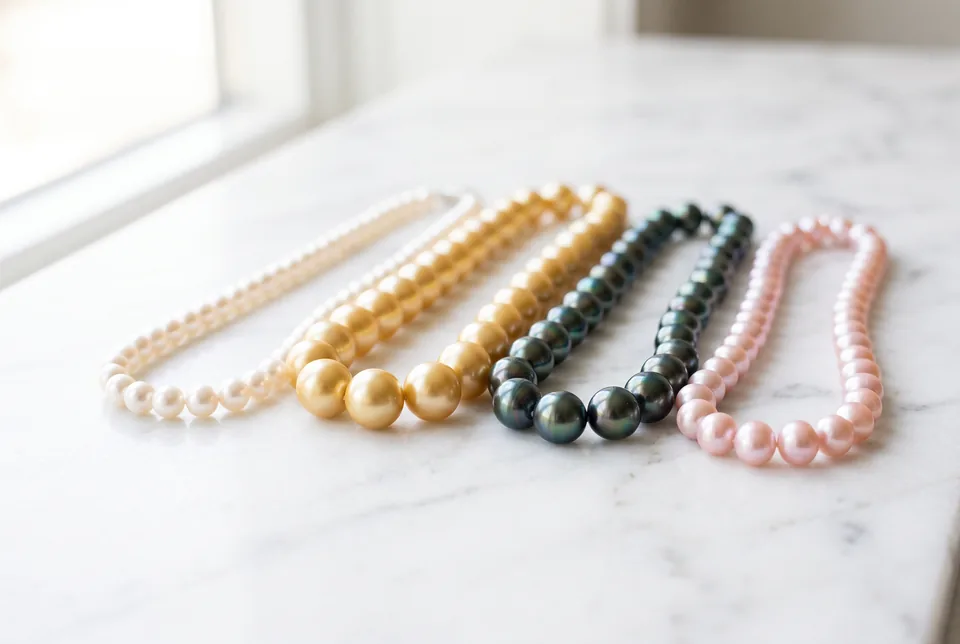
Most men reach for dark pearls, and that means Tahitian. These cultured pearls grow in the black-lipped pearl oyster Pinctada margaritifera in French Polynesia; the first farm was established in 1966 on the atoll of Manihi, and the first harvest came in 1972. The colours range from anthracite through peacock green to aubergine, and a Tahitian pearl may only be exported with a nacre layer of at least 0.8 mm. Nacre is the layer of calcium carbonate platelets the oyster builds around the inserted nucleus, and its thickness determines lustre and durability. Sizes run from 8 to 14 mm, with the bulk of the harvest at 9 to 11 mm.
Exactly where the men's size lies is something the trade cannot agree on. One German specialist retailer recommends 6 to 9 mm for men, whether white or black; a university department of gemstone and jewellery design gives 7 to 12 mm as the usual diameter for pearls in general; a Tahitian specialist only starts at 12 mm for men's jewellery on a leather cord. The middle ground is the best answer: 8 to 10 mm Tahitian pearls have presence on a man's neck without shouting like a statement piece, and they sit in the most affordable part of the price curve. Anyone who prefers light pearls should choose freshwater pearls of 8 to 9 mm, which mostly grow without a nucleus and are therefore especially robust. Akoya pearls from Japan at 7 to 9 mm are the classic choice for a single earring. South Sea pearls grow considerably larger, usually above 12 mm, and for men they often end up too big and too expensive. The differences between the four types are explained in detail in our comparison of Akoya, South Sea, Tahitian and freshwater pearls.
Size and length by style
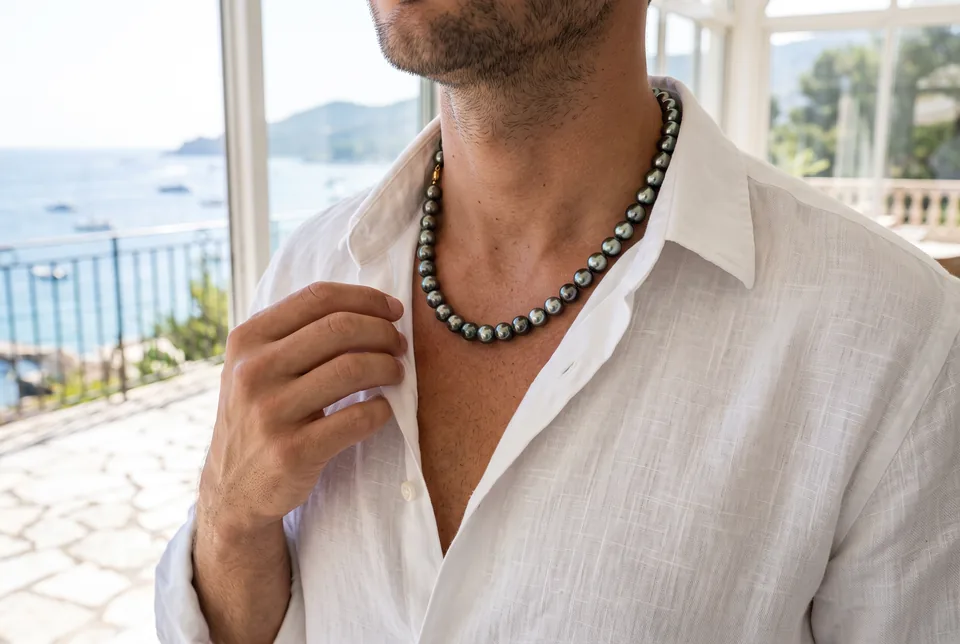
For men, length matters more than it does for women, because the strand sits over a shirt or T-shirt rather than disappearing into a neckline. Specialist retailers tend to offer men's strands longer than women's, precisely because they lie over the clothing. For the position most men are after, directly below the open collar button, 45 to 50 cm is this editorial team's recommendation: anything shorter quickly looks like a collar, and from about 55 cm the strand hangs on the chest and loses its tension.
| Style | Pearl type | Size | Length |
|---|---|---|---|
| Classic, below the open shirt collar | Tahitian, anthracite to green | 8 to 10 mm | 45 to 50 cm, individually knotted |
| Light, over a T-shirt | Freshwater, white or cream | 8 to 9 mm | 45 to 50 cm |
| Bold, on a leather cord | Tahitian, round or baroque | 11 to 13 mm | Single pearl, cord 45 to 55 cm |
| Discreet, on the ear | Akoya or Tahitian | 7 to 9 mm | One earring, stud or drop |
| Evening, double strand | Freshwater or Akoya | 7 to 8 mm | 40 to 44 cm, worn doubled |
Baroque means irregularly shaped, and these are precisely the pearls that often suit men better than perfect spheres: they look less like bridal jewellery and show visibly that they have grown. For the clasp, a plain ball in white gold or blackened silver is the rule, no flowers, no diamond pavé.
Single pearl and single earring
Anyone who would rather not start with a whole strand can start with one pearl. A single Tahitian pearl of 10 to 12 mm on a thin leather cord or a dark anchor chain is the most common way in, and it goes with jeans as readily as with a suit. The single earring in the style of the Met Gala works with an Akoya stud of 7 to 8 mm or a Tahitian drop, always on one ear, never as a pair. The principle comes from the Tudor court, where the gentlemen wore gold pearl earrings, and it holds unchanged today.
What men pay for pearls
One German online retailer lists 116 pearl necklaces between 169 and 8,995 euros; the cheapest piece is a collar with a single freshwater pearl, the most expensive a South Sea strand of 9.0 to 11.6 mm. Trier University of Applied Sciences sums up the market like this: a strand of 10 mm Akoya pearls costs several thousand euros, and South Sea or Tahitian strands with a white gold clasp reach five-figure sums. The price rises with every millimetre, and above 12 mm supply collapses, because only a fraction of oysters produce pearls of that size and the growing period is longer. Anyone who stays at 8 to 10 mm is buying where the harvest is broadest. A breakdown by pearl type and quality grade is given in our piece How much does a pearl necklace cost?
Wearing pearls every day
Nacre is softer than metal and sensitive to acid. Eau de toilette, aftershave and sweat attack the surface, so the strand goes on last and comes off first, and after wearing a soft, slightly damp cloth is all it needs. Worn over a shirt, the strand suffers less than it would against the skin, and it shows what it is meant to show. Anyone who wears it daily should have it restrung regularly, a matter of a few days at the jeweller. Then a well-grown Tahitian strand will outlast any trend.
Frequently asked questions
Can men wear pearl necklaces?
Yes. Henry VIII wears two necklaces in the Holbein portrait of 1536 to 1537, the Maharajas of Baroda owned a seven-strand natural pearl necklace, and since the Met Gala on 6 May 2019 the pearl earring on a man has become part of the street scene. According to the CPAA study of 2021, 42 to 47 per cent of men aged 25 to 45 find pearls attractive.
What pearl size suits men?
For a strand, 8 to 10 mm for Tahitian and 8 to 9 mm for freshwater; for a single earring, 7 to 9 mm. A single pearl on a leather cord can measure 10 to 13 mm. Above 12 mm the price rises steeply, because only a few oysters produce pearls that large.
How long should a men's pearl necklace be?
45 to 50 cm is this editorial team's recommendation. The strand then sits directly below the open collar button, neither tight like a collar nor hanging on the chest. Specialist retailers tend to offer men's strands longer than women's. Shorter lengths of 40 to 44 cm only work worn doubled as a double strand.
How much does a pearl necklace for men cost?
A necklace with a single freshwater pearl starts in the trade at under 200 euros; one German online retailer lists 116 pearl necklaces between 169 and 8,995 euros. A strand of 10 mm Akoya pearls costs several thousand euros, and Tahitian and South Sea strands with a white gold clasp reach five-figure sums.
Which celebrities wear pearls?
Harry Styles wore a single pearl earring at the Met Gala on 6 May 2019, A$AP Rocky has worn pearl necklaces regularly since 2019, Timothée Chalamet has appeared with a double strand and Tyler, the Creator with a pearl belt. The Lyst report for 2020 counted 150 per cent more jewellery purchases by men.
Are Tahitian pearls really black?
Rarely jet black; mostly anthracite, grey, peacock green or aubergine. They grow in the black-lipped pearl oyster Pinctada margaritifera; the first farm in French Polynesia was established in 1966 and the first harvest came in 1972. Only pearls with a nacre layer of at least 0.8 mm are exported.
Sources
- Baroda Pearl Necklace: Two-strand pearl necklace reconstituted from the original seven-strand Baroda Pearl Necklace Internetstones
- Pearls of Perfection: The Baroda Pearls Haute Living
- Harry Styles' 2019 Met Gala Outfit Included A Sheer Jumpsuit, Pearl Earrings, & Heels Bustle
- We Finally Know Who Pierced Harry Styles' Ear Before The Met Gala Refinery29
- Men Wearing Pearls Aren't Going Anywhere in 2023 Highsnobiety
- CPAA & MVI Release 2021 Benchmark Study of Consumer Preferences for Pearls Cultured Pearl Association of America
- Men Wearing Pearls: 2023's Hot Jewelry Trend Pure Pearls
- History of Cultured Pearls, Part Two: The South Seas and Tahiti GIA
- Weiche Typen, harter Kern: Warum Männer heute Perlenkette tragen Trier University of Applied Sciences, Gemstone and Jewellery Design
- Perlen für Herren Schmuckmüller
- Tahitian Pearl Sizes Explained: 8mm to 14mm The South Sea Pearl
- Perlenketten Edelkontor
- Portrait of Henry VIII Wikipedia
- Tudor Jewellery and Rings Berganza