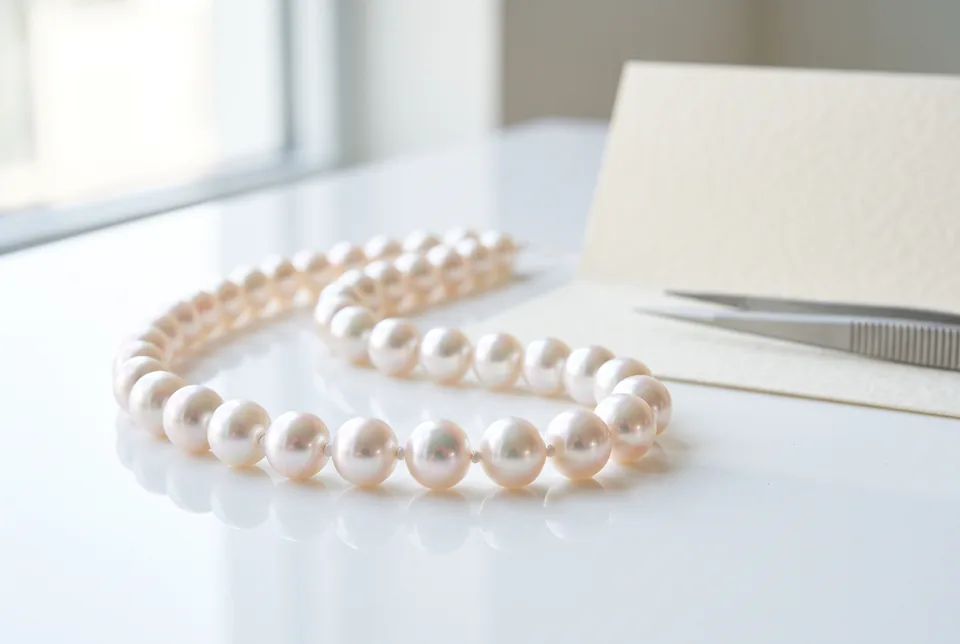
Orient is the trade term for the shimmering play of colour that travels across the surface as a pearl is turned, usually in pink, green and blue. It is not caused by pigment but by interference: light is reflected by the many stacked aragonite platelets, and the waves reinforce or cancel each other. The platelets are 0.3 to 0.5 micrometres thick, in the range of the wavelength of light.
Three terms are often confused. Lustre describes the sharpness of the reflection. Overtone is an even tint over the body colour, such as rose or silver on a white pearl. Orient is the moving rainbow effect. A pearl can have high lustre without orient, but the reverse hardly ever occurs.
Orient requires thick, evenly grown nacre. It is often entirely absent in Akoya pearls with 0.3 mm of nacre, but frequently pronounced in South Sea and natural pearls. The Pearl Science Laboratory in Tokyo tests for it under the name Aurora effect, using light from below, for the Hanadama certificate.
The pearl probe
Grab and turn, or pick a tone: the pearl shows how Akoya, South Sea, Tahitian and freshwater pearls behave in the light.