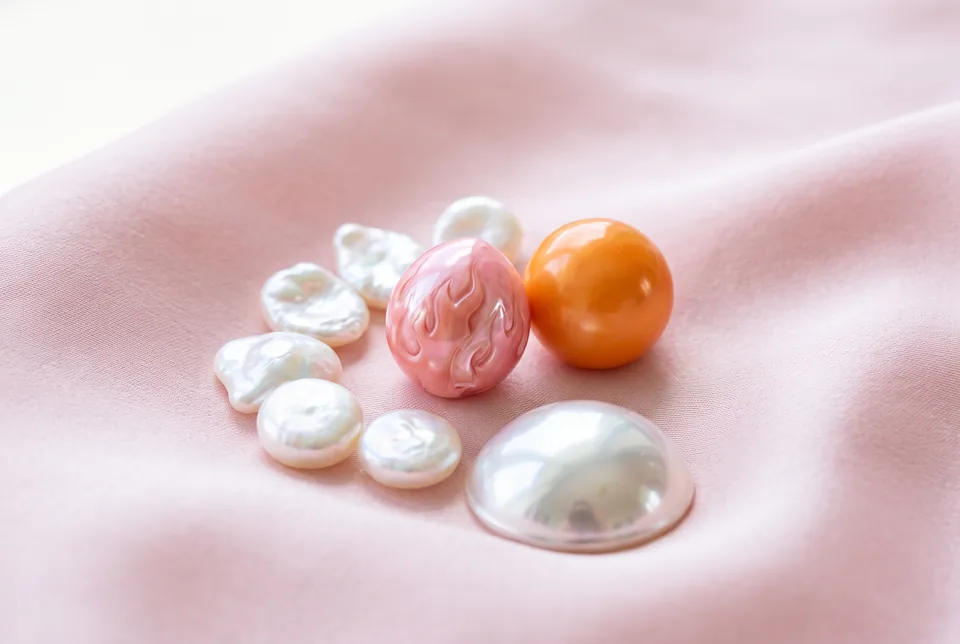
A mabe pearl does not form in the soft body of the oyster but on the inside of the shell. The farmer glues a dome-shaped nucleus of plastic or mollusc shell to the shell wall, and over several months to a year the oyster coats the dome with nacre.
After harvesting, the dome is sawn out of the shell, the nucleus is removed, the cavity is filled with resin and sealed with a disc of mother-of-pearl. The result is an assembled stone with a flat back. Typical sizes range from 10 to 20 mm, occasionally larger, because the shell offers more growing surface than a pearl sac.
For the price of one round South Sea pearl of the same size, you can buy several mabe. The price advantage has a downside: the nacre layer is thin and the filling is sensitive to knocks and solvents. Mabe belong in stud earrings, rings and pendants, not in necklaces. For the sister family of beadless keshi: Keshi, mabe, conch and melo.