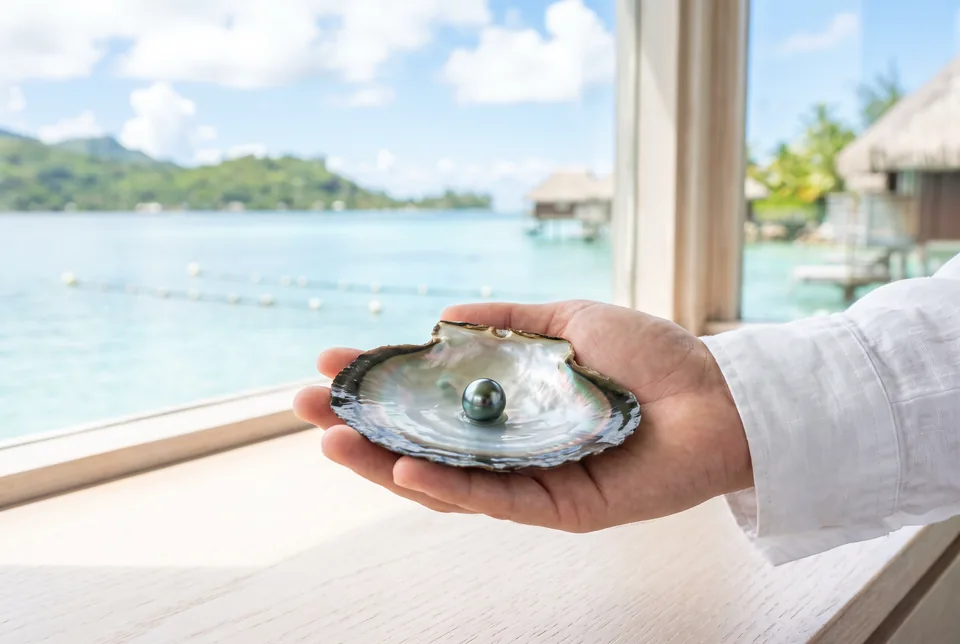
In bead culturing, the technician implants two things into the gonad of the oyster: a piece of mantle tissue from a donor mollusc and the nucleus, a polished sphere of mollusc shell. The tissue forms the pearl sac; the nucleus dictates shape and size. Almost all nuclei worldwide are turned from the shells of North American freshwater mussels from the Mississippi basin, because their shell material is dense, white and uniform.
The bead's share of the diameter is considerable. An 8 mm Akoya pearl with a 7 mm nucleus carries only 0.5 mm of nacre per side, so the bead accounts for more than 80 percent of the diameter. In South Sea pearls with 2 mm of nacre and more, this share drops significantly.
Freshwater pearls usually manage without a nucleus; there, the piece of tissue is enough. How the whole process works is described in the article How cultured pearls are made.